
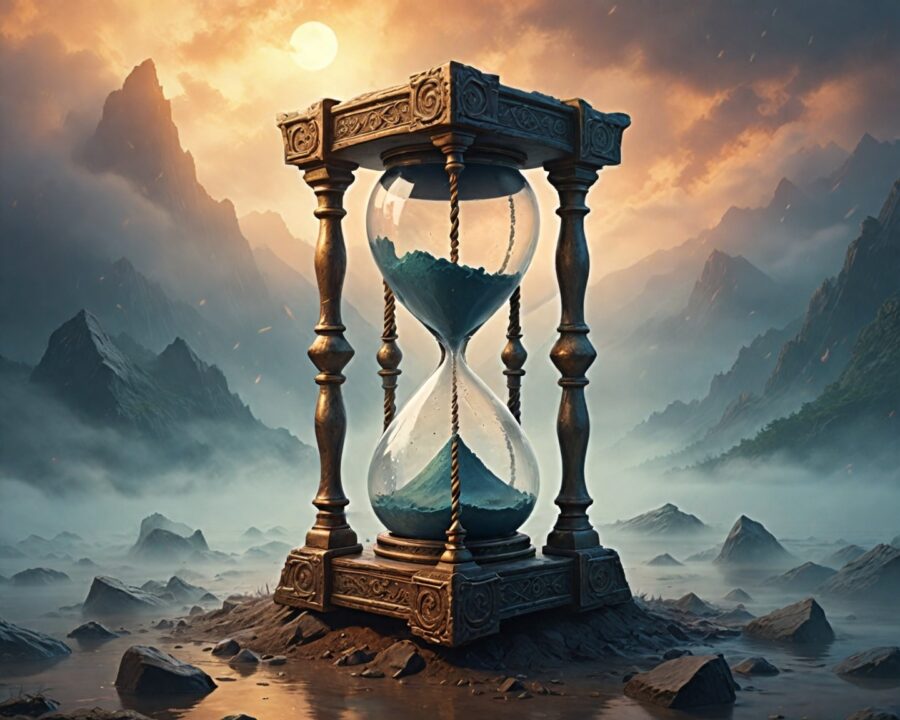
Introduction to Time in Mythology
Mythological stories have long been a cornerstone of human culture, offering a unique perspective on the world and the cosmos. These stories serve as a bridge between the tangible world and the divine, and one of their most intriguing elements is the representation of time. In many myths, time is not just a backdrop against which events unfold; it is a dynamic, sometimes sentient force that influences the narrative. Understanding how time operates in these ancient tales can provide profound insights into how different cultures perceive existence and cosmology.
Time in mythology is often depicted in a manner that defies the linear progression we experience in daily life. Instead, these myths frequently employ symbolic representations of time, weaving it into the very fabric of the stories to convey truths and lessons about life, nature, and the universe itself. From circular conceptions of time that emphasize renewal and rebirth to linear interpretations that propound inevitable destinies, the mythological treatment of time is as diverse as it is fascinating. This article will explore these representations across various cultures and contexts, revealing the sophisticated ways in which myths conceptualize the passage of time.
Symbolism of Time in Different Cultures
The symbolism of time varies significantly across different cultures, reflecting diverse worldviews and philosophical understandings. In ancient Egypt, time was embodied by the deity Thoth, who was seen as the god of wisdom and writing. Thoth’s association with the moon—a symbol of cyclical time—underscores a belief in the repetitive and eternal nature of time. Similarly, the cyclical calendar of the Maya civilization, with its intricate understanding of astronomical cycles, expresses a non-linear time perception centered around renewal.
In contrast, many Western cultures have traditionally embraced a more linear view of time. This is evident in the Judeo-Christian tradition, where time begins with the creation of the world and progresses towards an ultimate end with the Last Judgment. This linear progression is inherent in many biblical stories and deeply influences modern Western perspectives on time.
Hindu mythology offers yet another perspective, with its concept of “Kala,” the personification of time, depicted as both destroyer and creator. In Hindu narratives, time is both cyclical and immense, encompassing vast aeons known as Yugas. Each Yuga has a distinct phase within the larger cycle, emphasizing the endless renewal of life and moral evolution of the universe. These contrasting views illustrate how different cultures imbue time with varied symbolic meanings, shaping their histories and futures.
How Myths Explain the Concept of Eternity
Mythological tales often grapple with the concept of eternity, portraying it in forms that are both tangible and mystical. In Greek mythology, the notion of eternity is elegantly symbolized by the figure of Kronos, the Titan of Time. Kronos’s presence speaks to a time beyond human comprehension—a time that is not bounded by the mortal concerns and cycles of the human world.
Eternal time also finds expression in Norse mythology through the Yggdrasil tree, a colossal ash tree connecting the nine worlds of the Norse cosmos. Yggdrasil represents a living continuum, eternal in its existence, anchoring past, present, and future. This tree, ever-present and central to the fate of gods and men, emphasizes the everlasting nature of time and its omnipresence in all realms.
The Bhagavad Gita, a sacred Hindu scripture, also delves deeply into the concept of eternity, depicting it as a fundamental attribute of the divine. Krishna, addressing Arjuna, reveals that the soul is eternal and unchanging, transcending the physical confines of mortal time. This perspective reassures believers of their soul’s eternal nature, offering a profound understanding of timelessness and continuity beyond life and death.
The Role of Cycles and Seasons in Myths
Cycles and seasons play a pivotal role in mythological narratives, reflecting the intrinsic connection between human life and the natural world. Many myths mirror the agricultural cycles essential for survival, celebrating renewal and continuity through symbolic representations of animals, deities, and natural phenomena.
One prominent example is the Greek myth of Persephone, the goddess associated with springtime and renewal. Abducted by Hades, Persephone’s annual journey between the underworld and the surface is believed to influence the changing of the seasons. Her return heralds the onset of spring and abundance, while her descent marks the coming of winter, embodying the eternal cycle of life, death, and rebirth.
In Celtic mythology, the Wheel of the Year offers further evidence of cyclical time perception. The calendar marks the passage of time through eight festivals, each representing a transition within the cycle of life and nature. These include Samhain, marking the end of the harvest season, and Beltane, celebrating fertility and growth. This cyclical view underscores an understanding of life as an interconnected series of cycles.
Similarly, Native American myths often highlight seasonal shifts as metaphors for life’s phases. Stories of Coyote, a trickster figure in many tribes, illustrate both the unpredictability and consistency of the natural world, intertwining human destiny with the ever-turning wheel of time, governed by nature’s rhythms.
Time as a Character in Mythological Stories
In several mythological traditions, time itself is personified as a character, adding depth and complexity to the narratives. These personifications illustrate time’s profound impact on human destiny and its role as an active participant in the cosmic order.
In Roman mythology, Janus, the god of beginnings, transitions, and time, is depicted with two faces looking in opposite directions, symbolizing his ability to see both past and future. As the guardian of portals and doors, Janus embodies the concept of time as a passageway through which humans and events must travel, underscoring its importance as both a barrier and a pathway.
Similarly, in Hindu tradition, the goddess Kali, whose name derives from the word “kala” (time), is a complex figure who embodies destruction, creation, and the consuming nature of time. Kali’s fierce form serves as a potent reminder of time’s inexorability and the necessity of embracing change and transformation as fundamental aspects of existence.
Time’s embodiment also appears in the form of the Greek god Aion—a deity representing infinite time and the zodiac. Aion’s association with the cosmos illustrates a broader conception of time that governs both the visible universe and the spiritual realm, highlighting the interconnectedness of time, space, and divine order.
Comparing Linear vs Cyclical Time in Myths
The dichotomy between linear and cyclical conceptions of time is a significant theme in mythological storytelling. This diverse approach to understanding time reflects varying cultural perceptions of existence, progression, and destiny.
In linear mythology, time moves like an arrow toward a destined end. This view is prevalent in Western traditions, particularly in biblical epics where prophetic narratives and final reckonings are central themes. Linear myths often depict time as a forward-moving force, emphasizing inevitability, progress, and fate, such as the Christian eschatological narratives about the apocalypse and final judgment.
Cyclical time, conversely, is a common feature in Eastern philosophies and indigenous narratives. The concept of time as a repeated cycle is expressed in myths that focus on rebirth, regeneration, and the perpetuity of the cosmos. In Buddhist cosmology, the samsara—the cycle of birth, death, and rebirth—captures this endless turn of time, where life’s ultimate goal is liberation from these cycles through enlightenment.
| Attribute | Linear Time | Cyclical Time |
|---|---|---|
| Definition | Moves in a straight line | Repeats in a continuous loop |
| Focus | Progression and fate | Renewal and rebirth |
| Cultural Examples | Judeo-Christian Eschatology | Hindu Yugas, Wheel of Samsara |
Mythologies utilizing both perspectives offer a rich tapestry of human understanding regarding life’s journey, reflecting the varied ways cultures interpret their place in the universe.
How Ancient Myths Influence Modern Perceptions of Time
Ancient myths continue to influence modern perceptions of time, particularly in shaping cultural narratives and belief systems. These age-old stories embody archetypes and wisdom that transcend time, resonating with contemporary notions of existence and the cosmos.
Linear interpretations of time find a prominent place in modern society’s focus on progress and future-driven innovation. This view is embedded in technological, economic, and industrial narratives that emphasize forward momentum, much like the linear myths of destiny and prophecy. The prevalent idea of deadlines and schedules mirrors the linear race against time.
Conversely, the cyclical perception of time influences environmental and ecological movements that emphasize sustainability and balance, inspired by the natural cycles portrayed in myth. The increasing interest in mindfulness and holistic practices reflects an awareness of cyclical patterns and the importance of living in harmony with nature, drawing directly from mythological traditions that honor cycles and seasons.
Furthermore, modern storytelling in literature and film often revives these mythological themes, utilizing time travel, alternate realities, and timeless characters to explore human experience. Such narratives show time as both a mechanism for suspense and a medium for exploring existential themes, highlighting the enduring relevance of mythological time symbolism in shaping and expanding our collective imagination.
Common Questions About Time in Mythology
How do myths use time to explain natural phenomena?
Myths often use time to explain natural phenomena by embedding these events within cyclical patterns and divine narratives. The changing seasons, for example, are frequently depicted as a result of gods’ actions or spiritual forces influencing the earth.
Why is time represented as a cycle in many myths?
Cyclic time in myths represents the natural cycles observed in life, such as seasonal changes and life-death-rebirth processes. It reflects the belief that life is a series of repeating patterns and emphasizes continuity and renewal.
How do myths portray the end of time?
Myths often portray the end of time as an apocalyptic event or transformation leading to a new beginning. Such narratives serve as symbolic expressions of cosmic renewal and the perpetual nature of existence.
Can time be seen as a deity in mythology?
Yes, time is frequently personified as a deity in various mythologies. Examples include the Greek god Kronos and the Hindu goddess Kali, each embodying different aspects of time such as destruction, creation, and infinity.
Do myths from different cultures have similar time symbols?
While different cultures have unique depictions of time, there are common themes, such as cycles and the use of celestial bodies like the sun and moon to signify passage and renewal. These parallels suggest a shared human contemplation of existence and order.
How do mythological tales influence modern storytelling?
Modern storytelling draws heavily from mythological themes, utilizing enduring archetypes and symbolic elements like time travel and immortal characters to explore complex narratives and philosophical questions about life and existence.
What lessons about time can we learn from mythology?
Mythology teaches us about the impermanence of life, the inevitability of change, and the importance of harmony with nature’s cycles. These lessons remain relevant today, offering insights into living a balanced and purposeful life.
Practical Lessons from Mythological Time Concepts
Modern society can derive valuable lessons from mythological time concepts, which offer insights into living a meaningful and balanced life. The cyclical nature of time emphasized in myths can inspire individuals to embrace change and personal growth. By understanding life as a series of cycles, one can better accept the ebb and flow of successes and challenges, fostering resilience and adaptability.
Myths also stress the importance of patience and foresight, qualities that are especially pertinent in today’s fast-paced environment. Linear interpretations of time often lead to a relentless pursuit of progress, sometimes at the cost of well-being. Reflecting on mythological stories can encourage a more thoughtful approach to time management, emphasizing the need to balance ambition with rest and reflection.
Moreover, myths teach the value of harmony with the natural world. The cyclical view of time serves as a reminder of humanity’s interconnection with the environment, promoting sustainable practices that honor nature’s rhythms. By integrating these lessons from mythology, individuals and communities can cultivate a deeper appreciation for the present moment and strive for a harmonious existence in tune with the natural world.
Conclusion: The Enduring Relevance of Time in Myths
Mythological stories offer a rich tapestry of perspectives on time, providing valuable insights into the nature of existence and the human journey. By examining how time is represented in these narratives, we can appreciate the profound ways different cultures have understood and conveyed their cosmological and philosophical beliefs. Whether through linear trajectories or cyclical patterns, myths reveal the diverse approaches to capturing the essence of time across history.
The enduring relevance of mythological time symbolism is evident in both ancient wisdom and modern interpretations. As society navigates swift changes and complex challenges, drawing on the timeless guidance embedded in these stories can enrich understanding and inspire resilience. Time, as depicted in myths, serves as a reminder of life’s impermanence, emphasizing the importance of cultivating balance and living harmoniously with nature.
In conclusion, the symbolic representations of time in mythology continue to resonate, offering timeless truths that transcend cultural and historical boundaries. By exploring these narratives, we not only honor the wisdom of the past but also gain a deeper appreciation for the interconnectedness of all life. In the timeless dance of mythology and time, we find endless opportunities for learning, growth, and transformation, underscoring the enduring power and relevance of these ancient stories.