
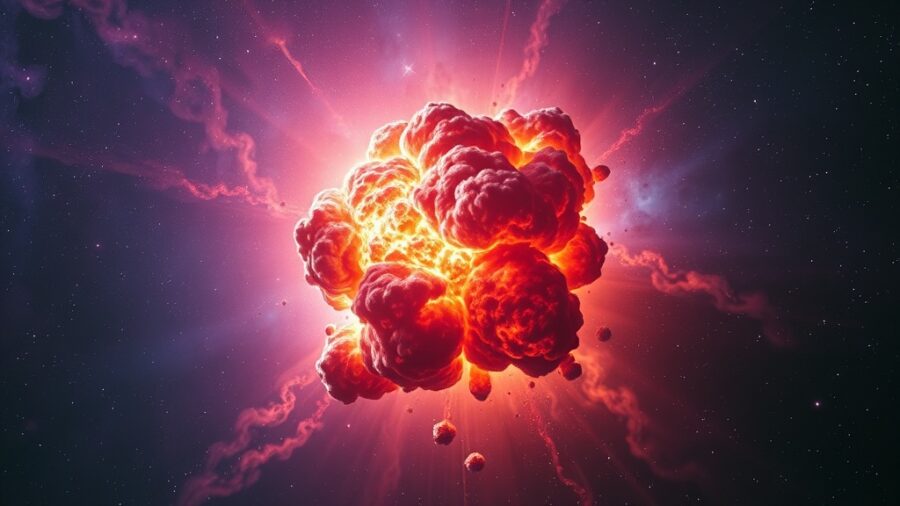
Explosive Star Deaths: Understanding Supernovae
Supernovae, the explosive star deaths that mark the end of a star’s life cycle, are some of the most phenomenal events in the universe. These cataclysmic explosions not only illuminate the cosmos but also play a crucial role in the formation of new celestial bodies. Understanding supernovae allows astronomers to gain insights into the evolution of stars, the expansion of the universe, and the synthesis of heavy elements. In this article, we will delve into the intricate details of supernovae, their life cycles, the mechanisms behind their explosions, and their significance in cosmic evolution.
As we explore the various types of supernovae, we will uncover the differences between core-collapse supernovae and thermonuclear supernovae, highlighting their unique characteristics and the processes that lead to their explosive deaths. Furthermore, we will examine the observational techniques employed by astronomers to study these cosmic phenomena, providing a glimpse into the future of supernova research and the unanswered questions that remain.
By the end of this article, readers will have a thorough understanding of supernovae, their role in the universe, and the exciting advancements in the field of astrophysics. Join us as we embark on this cosmic journey through the life and death of stars.
Introduction to Supernovae and Their Importance
What is a Supernova?
A supernova is a powerful explosion that occurs at the end of a star’s life cycle. This event releases an enormous amount of energy, often outshining entire galaxies for a brief period. Supernovae can be classified into two main categories: Type I and Type II. Type I supernovae arise from binary star systems where one star is a white dwarf, while Type II supernovae result from the rapid collapse of massive stars. Each type offers unique insights into stellar evolution and the chemical enrichment of the universe.
The Significance of Supernovae in Astronomy
Supernovae are not just spectacular events; they are fundamental to our understanding of the universe. They are responsible for dispersing heavy elements such as iron, nickel, and other metals into the interstellar medium. This process is crucial for the formation of new stars and planets, as these elements contribute to the chemical composition of the cosmos. Moreover, studying supernovae helps astronomers measure cosmic distances and the expansion rate of the universe, providing evidence for phenomena like dark energy.
The Life Cycle of Stars Leading to Supernovae
The Stellar Evolution Process
The life cycle of a star is a complex process that spans millions to billions of years. Stars begin their lives in nebulae, where they gather mass and ignite nuclear fusion. As they evolve, stars go through various stages, including the main sequence, red giant, and, ultimately, their death throes. For massive stars, this culminates in a supernova explosion, while smaller stars may end as white dwarfs or neutron stars. Understanding these stages is essential for comprehending the conditions that lead to supernovae.
Stages of Stellar Death
The final stages of a massive star’s life are marked by several key processes:
- Hydrogen Burning: The star fuses hydrogen into helium in its core.
- Helium Burning: Once hydrogen is depleted, helium is fused into heavier elements.
- Core Collapse: Eventually, iron accumulates in the core, leading to gravitational collapse when fusion can no longer counteract gravitational forces.
- Explosion: The outer layers are expelled violently, resulting in a supernova.
Types of Supernovae: A Detailed Overview
Type I Supernovae
Type I supernovae are divided into several subcategories, primarily Type Ia, which are crucial for measuring astronomical distances. These supernovae occur in binary systems, where one star is a white dwarf. When the white dwarf accumulates enough mass from its companion star, it undergoes a thermonuclear explosion. This explosion is characterized by a consistent peak brightness, making Type Ia supernovae reliable distance indicators in cosmology.
Type II Supernovae
Type II supernovae result from the core collapse of massive stars (greater than 8 solar masses). As the star exhausts its nuclear fuel, it can no longer support itself against gravity, leading to a catastrophic collapse. The core becomes incredibly dense, and the resulting shock wave ejects the outer layers of the star, creating a luminous explosion. Type II supernovae are often associated with the formation of neutron stars or black holes, depending on the progenitor mass.
The Mechanisms Behind Supernova Explosions
Core-Collapse Mechanism
The core-collapse mechanism is primarily responsible for Type II supernovae. When a massive star runs out of nuclear fuel, its core collapses under gravity, leading to a rapid increase in density and temperature. This process results in the formation of a neutron star or black hole, and the subsequent rebound effect creates a shock wave that propels the star’s outer layers into space. The energy released during this explosion can be equivalent to the energy output of the sun over its entire lifetime.
Thermonuclear Explosion Mechanism
The thermonuclear explosion mechanism of Type Ia supernovae involves a runaway fusion reaction in a white dwarf. As the white dwarf accretes material from a companion star, it approaches the Chandrasekhar limit (approximately 1.4 solar masses). Once this limit is reached, carbon and oxygen in the core ignite explosively, leading to a complete disruption of the star. The uniformity of these explosions makes them essential for understanding cosmic expansion.
The Role of Supernovae in Cosmic Evolution
Element Formation and Distribution
Supernovae play a critical role in the synthesis and distribution of heavy elements in the universe. During the explosion, elements such as gold, silver, and uranium are formed through nucleosynthesis and then ejected into space. This process enriches the interstellar medium, contributing to the formation of new stars, planets, and eventually, life. For example, it is estimated that approximately half of the elements heavier than helium in the universe were formed in supernovae.
Impact on Galactic Structures
The energy released by supernovae influences the structure and evolution of galaxies. The shock waves generated by these explosions can trigger the formation of new stars by compressing surrounding gas and dust. Additionally, supernovae can disrupt existing star formations and contribute to the dynamics of galactic outflows, impacting the galaxy’s evolution over time. The feedback mechanisms initiated by supernovae are essential for understanding the lifecycle of galaxies.
Observational Techniques for Studying Supernovae
Telescopic Observations
Astronomers utilize various telescopes to observe supernovae across different wavelengths, including optical, infrared, and radio. Ground-based telescopes like the Very Large Telescope (VLT) and space-based observatories such as the Hubble Space Telescope (HST) have all contributed to our understanding of supernovae. These observations allow scientists to analyze the light curves and spectra of supernovae, providing insights into their composition and distance.
Gravitational Wave Astronomy
With advancements in technology, gravitational wave astronomy has emerged as a powerful tool for studying supernovae. When a supernova occurs, it can produce gravitational waves, ripples in spacetime that can be detected by observatories like LIGO and Virgo. These observations provide complementary data to electromagnetic observations, enhancing our understanding of the physics behind supernova explosions.
Future Research Directions in Supernova Studies
New Observational Techniques
The future of supernova research lies in the development of new observational techniques and technologies. Projects like the Large Synoptic Survey Telescope (LSST) aim to provide real-time data on transient astronomical events, including supernovae. This will enable astronomers to study the early stages of supernovae and their aftermath, offering insights into the mechanisms behind these explosions.
Theoretical Models and Simulations
As computational power increases, theoretical models and simulations will play a crucial role in understanding supernovae. Researchers are developing sophisticated simulations to model the physical processes involved in supernova explosions and their aftermath. These models will help refine our understanding of supernovae and their implications for cosmic evolution, potentially leading to new discoveries in the field.
Conclusion and Implications of Supernova Research
In conclusion, supernovae represent one of the most spectacular phenomena in the cosmos, marking the explosive deaths of stars and playing a vital role in the evolution of the universe. Through the study of supernovae, astronomers can glean insights into stellar evolution, element formation, and the dynamics of galaxies. The ongoing research and advancements in observational techniques promise to deepen our understanding of these explosive star deaths and their significance in the cosmic tapestry.
As we continue to unlock the mysteries of supernovae, we pave the way for future discoveries that may revolutionize our understanding of the universe and our place within it. The implications of supernova research extend beyond astronomy, influencing fields such as cosmology, astrophysics, and even the study of the origins of life.
Frequently Asked Questions about Supernovae
What causes a star to become a supernova?
A star becomes a supernova when it reaches the end of its life cycle, either through core collapse in massive stars or through a thermonuclear explosion in white dwarfs. The process involves the exhaustion of nuclear fuel and the inability to counteract gravitational forces, leading to a dramatic explosion.
What are the two main types of supernovae?
The two main types of supernovae are Type I and Type II. Type I supernovae occur in binary systems with white dwarfs, while Type II supernovae result from the core collapse of massive stars. Each type provides unique insights into stellar evolution.
How do supernovae contribute to the formation of new stars?
Supernovae disperse heavy elements into the interstellar medium, enriching the gas and dust that form new stars and planets. The shock waves generated by the explosion can also compress surrounding material, triggering star formation.
What role do supernovae play in measuring cosmic distances?
Type Ia supernovae have a consistent peak brightness, making them valuable tools for measuring cosmic distances. By observing their brightness, astronomers can determine how far away they are, contributing to our understanding of the expansion of the universe.
What future advancements can we expect in supernova research?
Future advancements in supernova research will likely involve new observational techniques, such as the Large Synoptic Survey Telescope (LSST), and enhanced theoretical models and simulations. These developments will deepen our understanding of supernovae and their role in cosmic evolution.
- Supernovae are explosive deaths of stars, crucial for cosmic evolution.
- Two main types: Type I (thermonuclear) and Type II (core-collapse).
- Supernovae enrich the universe with heavy elements necessary for life.
- Observational techniques include telescopes and gravitational wave astronomy.
- Future research will focus on real-time observations and advanced simulations.
- Supernovae help measure cosmic distances and the universe’s expansion rate.
- These events impact galactic structures and trigger new star formation.
- Understanding supernovae enhances our knowledge of the universe’s origins.