
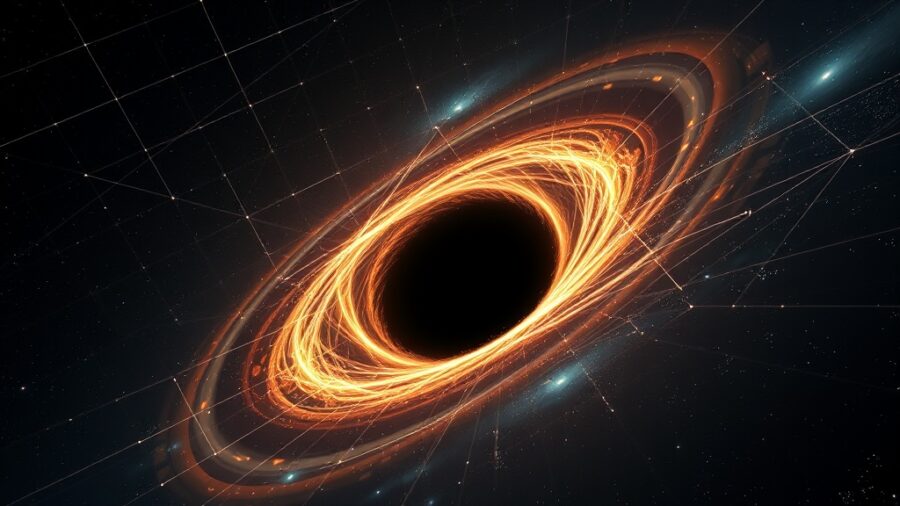
Black Hole Information Paradox: An In-Depth Exploration
The black hole information paradox is one of the most intriguing and perplexing issues in modern theoretical physics. This paradox arises from the conflict between quantum mechanics and general relativity, particularly concerning the fate of information that falls into black holes. As scientists delve deeper into the nature of black holes, this paradox continues to fuel debates and inspire new theories. In this article, we will explore the historical background of black holes, the theoretical foundations of information loss, the implications of Hawking radiation, and the role of quantum mechanics and entanglement in this fascinating phenomenon.
Understanding the black hole information paradox requires a journey through complex concepts and pioneering research. We will dissect the theoretical underpinnings of black holes, examine key figures such as Stephen Hawking, and discuss the latest developments in the field. The implications of this paradox extend beyond theoretical physics and challenge our fundamental understanding of reality itself.
Throughout this article, readers will gain insight into the essence of black holes, the implications of information loss, and the ongoing debates surrounding potential resolutions to the paradox. By the end, you will be equipped with a comprehensive understanding of the black hole information paradox and its significance in the realm of theoretical physics.
Historical Background of Black Holes
The Birth of Black Hole Theory
The concept of black holes dates back to the late 18th century, with the first serious suggestion coming from the British natural philosopher John Michell in 1783. Michell proposed that if a star were massive enough and compact enough, its gravitational pull would be so strong that not even light could escape it. This early idea laid the groundwork for future explorations of black holes.
It wasn’t until the early 20th century that Albert Einstein’s theory of general relativity provided the mathematical framework necessary to describe black holes. In 1915, Einstein formulated the equations of general relativity, which describe how mass and energy warp spacetime. The solutions to these equations led to the prediction of objects with gravitational fields so intense that escape would be impossible.
Recognition and Acceptance
Despite the theoretical underpinnings, black holes remained a topic of skepticism for many years. It wasn’t until the 1960s that the existence of black holes gained broader acceptance among physicists. The work of scientists like John Archibald Wheeler, who coined the term “black hole” in 1967, helped bring attention to these enigmatic objects.
Furthermore, the discovery of pulsars in the early 1970s provided indirect evidence for the existence of black holes. Pulsars are rotating neutron stars that emit beams of radiation, and their behavior can be explained by the presence of a black hole. This discovery contributed to a paradigm shift in astrophysics, leading to increased interest and research into black holes.
| Year | Event | Significance |
|---|---|---|
| 1783 | John Michell proposes black holes | First theoretical mention of black holes |
| 1915 | Einstein’s General Relativity | Mathematical foundation for black holes |
| 1967 | John Archibald Wheeler coins “black hole” | Increased awareness and acceptance |
| 1970s | Discovery of pulsars | Indirect evidence for black holes |
Theoretical Foundations of Information Loss
Understanding Information in Quantum Mechanics
In quantum mechanics, information is a fundamental concept that describes the state of a system. When matter falls into a black hole, it appears that all information about that matter is lost to the outside universe, which contradicts a core principle of quantum mechanics: that information cannot be destroyed. This leads to the crux of the black hole information paradox.
The implications of information loss challenge the fundamental tenets of both quantum mechanics and relativity. If information is indeed lost when matter falls into a black hole, it raises questions about the nature of reality and the laws of physics as we understand them. For instance, if information can be lost, it suggests a breakdown of predictability in physical systems, which is a cornerstone of quantum theory.
Black Holes and the No-Hair Theorem
The no-hair theorem posits that black holes can be fully described by just three observable properties: mass, charge, and angular momentum. This theorem implies that all information about the matter that formed a black hole or fell into it is erased, leading to the assertion that the specific details of the matter are irrelevant to the black hole’s characteristics.
This concept further complicates the information paradox, as it seems to support the idea that information is lost forever. However, recent advancements in theoretical physics have suggested that this may not be the case. Some physicists argue that information could be encoded in the black hole’s event horizon or released through Hawking radiation, a topic we will explore in the next section.
Hawking Radiation and Its Implications
The Discovery of Hawking Radiation
In 1974, physicist Stephen Hawking made a groundbreaking discovery that altered our understanding of black holes. He proposed that black holes are not completely black; instead, they emit radiation due to quantum effects near the event horizon. This phenomenon, now known as Hawking radiation, suggests that black holes can slowly lose mass and energy over time.
The implications of Hawking radiation are profound. If black holes emit radiation, they may eventually evaporate completely, potentially releasing information back into the universe. This raises intriguing questions about whether information can escape a black hole after all, thus leading to a potential resolution of the information paradox.
Black Hole Evaporation and Information Recovery
Hawking’s theory suggests that as a black hole evaporates, it becomes increasingly smaller until it ultimately disappears. The process of evaporation would involve the emission of Hawking radiation, which is composed of particles that carry information about the initial state of the black hole.
However, the question remains: does this radiation contain complete information about the matter that formed the black hole? The debate continues among physicists regarding whether Hawking radiation carries all the information or if it is somehow altered or lost in the process.
- Theoretical implications of Hawking radiation.
- The potential for information recovery through black hole evaporation.
- The ongoing debate among physicists regarding information loss.
Entanglement and Quantum Mechanics
The Role of Quantum Entanglement
Quantum entanglement is a phenomenon where particles become interconnected in such a way that the state of one particle cannot be described independently of the state of another, no matter how far apart they may be. This concept has significant implications for the black hole information paradox.
Some researchers propose that information falling into a black hole could be preserved through quantum entanglement. As matter enters the black hole, it may become entangled with radiation on the event horizon, which could allow the information to be recovered even after the black hole has evaporated.
Black Holes and Information Preservation
The idea of information preservation through entanglement challenges the notion of information loss. If entangled particles maintain their connection, it suggests that information could be retained, even if it appears to be lost to the outside universe. This perspective opens new avenues for understanding the nature of information in black holes and its potential recovery.
Researchers are actively investigating the implications of entanglement in black holes, exploring whether it offers a viable solution to the information paradox. This research could reshape our understanding of both quantum mechanics and the nature of reality.
| Concept | Description | Implications |
|---|---|---|
| Hawking Radiation | Emission of radiation by black holes | Potential information recovery |
| Quantum Entanglement | Interconnection of particles | Possibility of information preservation |
Recent Developments and Debates
Ongoing Research and Theoretical Advances
In recent years, the black hole information paradox has gained renewed attention as physicists seek to resolve the tension between quantum mechanics and general relativity. Various theoretical frameworks have been proposed, including the holographic principle, which posits that all information in a volume of space can be represented as a two-dimensional surface.
This principle suggests that black holes may encode information on their event horizons, which could provide a pathway for recovering lost information. Researchers are exploring the implications of this theory, which could bridge gaps between quantum mechanics and gravitational theories.
Debates Among Physicists
The black hole information paradox has sparked intense debates within the scientific community. Some physicists argue in favor of information loss, while others maintain that information is preserved in some form. This ongoing discourse highlights the complexities of understanding black holes and the fundamental principles of physics.
Conferences and symposiums continue to host discussions on this topic, with leading physicists presenting their findings and theories. The debate is not just about theoretical implications; it also raises questions about the nature of reality, the fabric of spacetime, and the limits of human understanding.
Potential Resolutions to the Paradox
The Holographic Principle
The holographic principle is a revolutionary idea that suggests all the information contained within a volume of space can be represented on its boundary. This concept has gained traction as a potential resolution to the black hole information paradox. According to this principle, the information that falls into a black hole could be encoded on its event horizon, allowing it to be retained rather than lost.
This theory aligns with the idea that black holes are not just simple objects, but rather complex systems that may hold more information than previously thought. The holographic principle has profound implications for our understanding of black holes and the nature of information in the universe.
Firewall Hypothesis
The firewall hypothesis is another proposed solution to the information paradox. This concept suggests that there exists a “firewall” at the event horizon of a black hole, which would incinerate anything that tries to enter. While this idea resolves the paradox by ensuring that information is destroyed, it presents its own set of challenges and conflicts with established principles of physics.
The debate surrounding the firewall hypothesis continues, as physicists weigh its implications against other theories. This ongoing exploration reflects the dynamic nature of scientific inquiry and the quest for a deeper understanding of black holes and information.
- Holographic principle as a potential resolution.
- Firewall hypothesis and its implications.
- Ongoing debates within the scientific community.
Conclusion and Future Directions
The black hole information paradox remains one of the most profound and challenging issues in theoretical physics. As we explored in this article, the paradox highlights the conflict between quantum mechanics and general relativity, raising questions about the nature of information and reality itself. From the historical background of black holes to the implications of Hawking radiation and the role of quantum entanglement, the journey through this topic reveals the complexities of our universe.
Recent developments, including the holographic principle and the firewall hypothesis, demonstrate that physicists are actively seeking resolutions to this paradox. While the debate continues, each new theory brings us one step closer to understanding the fundamental nature of black holes and the information they may or may not retain.
As we move forward, continued research and exploration will be essential in unraveling the mysteries of black holes. The quest for knowledge in this field not only deepens our understanding of the cosmos but also challenges our perceptions of reality, paving the way for future discoveries.
Frequently Asked Questions
What is the black hole information paradox?
The black hole information paradox refers to the conflict between quantum mechanics and general relativity regarding the fate of information that falls into a black hole. It raises questions about whether information is lost forever or preserved in some form.
Who first proposed the existence of black holes?
The concept of black holes was first suggested by John Michell in 1783. However, the modern understanding of black holes emerged from Albert Einstein’s theory of general relativity in 1915.
What is Hawking radiation?
Hawking radiation is a theoretical prediction made by physicist Stephen Hawking in 1974, suggesting that black holes emit radiation due to quantum effects near the event horizon. This radiation could lead to the gradual evaporation of black holes over time.
Can information be recovered from a black hole?
The debate regarding information recovery from black holes is ongoing. Some theories, such as the holographic principle, suggest that information may be encoded on the event horizon, while others propose that information is lost forever.
What are the potential resolutions to the black hole information paradox?
Potential resolutions include the holographic principle, which posits that information is encoded on the event horizon, and the firewall hypothesis, which suggests that a firewall at the event horizon destroys information. The scientific community continues to explore these and other theories.
Recap
- The black hole information paradox highlights the conflict between quantum mechanics and general relativity.
- Black holes were first theorized in the 18th century, gaining acceptance in the 20th century.
- Hawking radiation suggests that black holes can emit radiation and may eventually evaporate.
- Quantum entanglement may provide a mechanism for information preservation.
- The holographic principle and firewall hypothesis are potential resolutions to the paradox.
- Ongoing debates among physicists reflect the complexities of understanding black holes.
- Future research will continue to shape our understanding of black holes and the nature of information.
- The quest for knowledge in this field challenges our perceptions of reality and the fabric of the universe.