
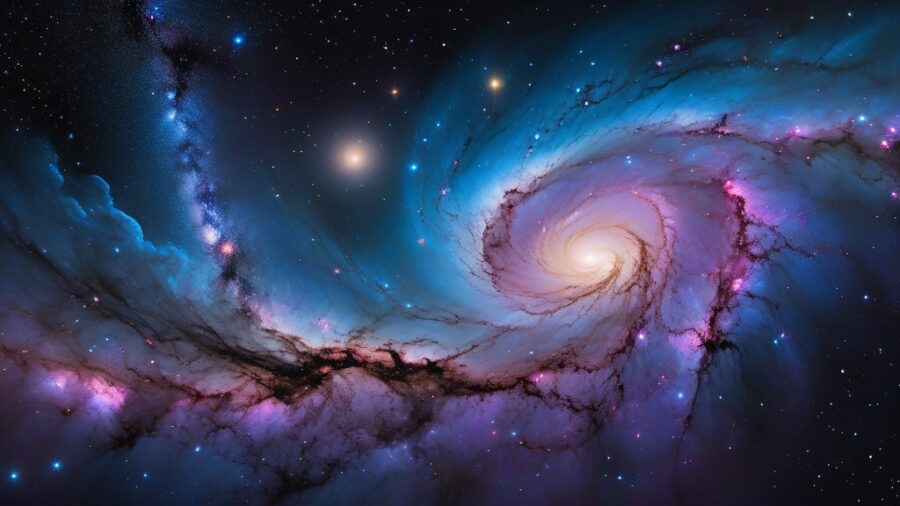
Introduction to Superluminal Expansion
The concept of superluminal expansion refers to the phenomenon where certain regions of space appear to be expanding faster than the speed of light. This intriguing idea challenges our understanding of the universe and has profound implications for cosmology and physics. In this article, we will explore the intricacies of superluminal expansion, delve into the physics behind space stretching, and examine how this phenomenon fits into our broader understanding of the cosmos.
Superluminal expansion is not just a theoretical concept; it has practical implications that can alter our perception of time, distance, and the very fabric of space. As we delve deeper into this topic, we will uncover the historical context that has shaped our understanding of superluminal expansion and the key figures involved in its development. By the end of this article, you will have a comprehensive understanding of how superluminal expansion operates and its significance in contemporary astrophysics.
This exploration will take us through various aspects of superluminal expansion, including the physics behind it, its implications for cosmology, and how it compares to sub-luminal expansion. We will also look into future research directions that promise to expand our understanding of this fascinating topic. Join us as we embark on this intellectual journey through the vastness of space and time.
The Physics Behind Space Stretching
Understanding the Basics
The principles of superluminal expansion are rooted in Einstein’s theory of relativity, which states that nothing can travel faster than the speed of light in a vacuum. However, when we discuss superluminal expansion, we are not referring to objects moving through space faster than light. Instead, we are speaking about the expansion of space itself, which can occur at a rate greater than the speed of light without violating the laws of physics.
This expansion is often illustrated through the concept of the cosmic inflation theory, which suggests that the universe underwent rapid expansion shortly after the Big Bang, growing exponentially in a fraction of a second. During this period, distances between points in space expanded faster than light could travel, leading to the current large-scale structure of the universe.
The Role of Dark Energy
Another critical aspect of superluminal expansion is the role of dark energy. Observations of distant supernovae and the cosmic microwave background radiation suggest that the universe’s expansion is accelerating. This acceleration is attributed to dark energy, a mysterious force that constitutes about 68% of the universe. Dark energy alters the dynamics of cosmic expansion, allowing for regions of space to stretch at superluminal rates.
Historical Context of Superluminal Expansion
Key Developments in Cosmology
The idea of superluminal expansion can be traced back to the early 20th century with the formulation of general relativity by Albert Einstein in 1915. However, it was not until the late 20th century that observations began to suggest that the universe was expanding at an accelerating rate. In 1998, two independent research teams, the Supernova Cosmology Project and the High-Z Supernova Search Team, provided evidence for this acceleration through their observations of distant supernovae.
This breakthrough led to a paradigm shift in cosmology, as scientists realized that the universe’s expansion was not only ongoing but also accelerating. The implications of this discovery prompted further investigations into the nature of dark energy and its relationship with superluminal expansion. These developments have also led to the exploration of various theoretical frameworks, including scalar fields and modified gravity theories.
Influential Figures and Theories
Several notable physicists have contributed to the understanding of superluminal expansion. In particular, Alan Guth is renowned for proposing the inflationary model of the universe in 1980. His ideas provided a framework for explaining the uniformity of the cosmos and the large-scale structure we observe today. Other significant contributors include Stephen Hawking, who explored the implications of black holes and their relationship with cosmic expansion.
Implications of Superluminal Expansion on Cosmology
Impact on the Universe’s Fate
The implications of superluminal expansion extend to the ultimate fate of the universe. Current models suggest that as the universe continues to expand at accelerating rates, it may lead to a scenario known as the Big Freeze, where galaxies drift apart, and the universe becomes increasingly cold and empty. This perspective raises important questions about the long-term sustainability of cosmic structures and the potential for new forms of matter or energy to arise.
Additionally, the understanding of superluminal expansion influences theories regarding the multiverse. Some interpretations suggest that our universe may be one of many, each with its own properties and expansion rates. This notion opens up avenues for exploring how different universes may interact or be completely isolated from one another.
Challenges in Observations and Measurements
Despite the theoretical advancements, observational challenges remain significant in studying superluminal expansion. Measuring distances in the universe is inherently complex due to the vast scales involved. Techniques such as redshift measurements and the use of standard candles like supernovae have provided valuable data, but uncertainties persist.
Furthermore, models of dark energy and cosmic expansion are continually refined as new observations emerge. The European Space Agency’s Euclid mission, scheduled for launch in 2022, aims to map the geometry of the dark universe and provide further insights into the nature of superluminal expansion. These advancements in observational cosmology are crucial for enhancing our understanding of the universe’s evolution.
Comparison: Superluminal vs. Sub-Luminal Expansion
Defining the Two Concepts
When discussing cosmic expansion, it is essential to differentiate between superluminal and sub-luminal expansion. Superluminal expansion refers to regions of space where distances are increasing faster than light can travel, while sub-luminal expansion involves speeds below the speed of light.
Sub-luminal expansion is commonly observed in local galactic dynamics, where galaxies move through space but are bound by gravitational forces. In contrast, superluminal expansion often relates to the large-scale structure of the universe and the effects of dark energy. These distinctions have significant implications for how we model cosmic evolution and the forces that govern it.
Causal Relationships and Observational Effects
One of the key differences between superluminal and sub-luminal expansion is the causal relationship between events. In a sub-luminal framework, information and matter can interact within a causal structure, meaning that changes in one region can affect another. Conversely, in a superluminal context, regions of space may become causally disconnected, as light from one region may never reach another due to the rapid expansion of space.
This observation leads to intriguing questions about the nature of causality in the universe and the potential for events to unfold without any direct influence from other regions. Understanding these distinctions is crucial for developing more accurate cosmological models and predictions.
| Aspect | Superluminal Expansion | Sub-Luminal Expansion |
|---|---|---|
| Speed | Faster than the speed of light | Slower than the speed of light |
| Causal Relationships | Regions may be causally disconnected | Events can influence one another |
| Examples | Cosmic inflation, dark energy effects | Local galactic dynamics |
| Implications | Multiverse theories, cosmic fate uncertainties | Gravitational binding, local structure formation |
Future Research Directions in Space Stretching
Emerging Technologies and Methods
The future of research on superluminal expansion and space stretching holds exciting potential. Advancements in technology, such as gravitational wave detectors and high-energy particle colliders, are expected to provide new insights into the fundamental forces that govern the universe. These technologies will allow researchers to probe the effects of dark energy and its role in cosmic expansion with greater precision.
Furthermore, the development of next-generation telescopes, such as the James Webb Space Telescope, will enhance our ability to study distant galaxies and the cosmic microwave background radiation. By analyzing light from the early universe, scientists hope to uncover clues about the conditions that led to superluminal expansion and the subsequent evolution of the cosmos.
Interdisciplinary Approaches
Future research will likely require interdisciplinary collaboration between physicists, astronomers, and cosmologists. The complexities of superluminal expansion necessitate a holistic approach that integrates theoretical models with observational data. Collaborative initiatives, such as the Event Horizon Telescope, which aims to capture images of black holes, emphasize the importance of teamwork in advancing our understanding of the universe.
Conclusion
In conclusion, superluminal expansion is a fascinating and complex phenomenon that challenges our understanding of the universe. Through the exploration of its underlying physics, historical context, and implications for cosmology, we have seen how this concept reshapes our perception of space and time. The distinction between superluminal and sub-luminal expansion highlights the intricacies of cosmic dynamics and the ongoing quest for knowledge within the scientific community.
As research continues to evolve, the future holds promise for uncovering new truths about the universe’s expansion, dark energy, and the potential for new forms of matter and energy. The journey into the unknown is far from over, and the implications of superluminal expansion will undoubtedly continue to captivate the imagination of scientists and enthusiasts alike.
Frequently Asked Questions (FAQ)
What is superluminal expansion?
Superluminal expansion refers to the phenomenon where certain regions of space appear to be expanding faster than the speed of light. This does not violate the principles of relativity, as it is the fabric of space itself that is stretching.
How does dark energy relate to superluminal expansion?
Dark energy is thought to be responsible for the accelerated expansion of the universe. It constitutes about 68% of the universe and alters the dynamics of cosmic expansion, allowing for superluminal rates.
What are the implications of superluminal expansion for the universe’s fate?
Superluminal expansion may lead to scenarios such as the Big Freeze, where galaxies drift apart, and the universe becomes increasingly cold and empty. It also raises questions about the potential existence of a multiverse.
How does superluminal expansion differ from sub-luminal expansion?
Superluminal expansion involves regions of space expanding faster than light, while sub-luminal expansion refers to speeds below light. The former can lead to causal disconnection between regions, while the latter allows for interactions.
What technologies are being developed to study superluminal expansion?
Emerging technologies, such as gravitational wave detectors and the James Webb Space Telescope, will enhance our ability to study cosmic expansion and its implications. These advancements promise new insights into the nature of dark energy and space stretching.
Recap
- Superluminal expansion refers to regions of space expanding faster than light.
- Dark energy plays a crucial role in the accelerated expansion of the universe.
- Historical developments have shaped our understanding of superluminal expansion.
- Superluminal and sub-luminal expansions have distinct implications for cosmology.
- Future research will leverage emerging technologies and interdisciplinary collaboration.
- The fate of the universe may be influenced by superluminal expansion scenarios.
- Current observational challenges remain significant in studying cosmic dynamics.
- Understanding superluminal expansion reshapes our perception of space and time.