
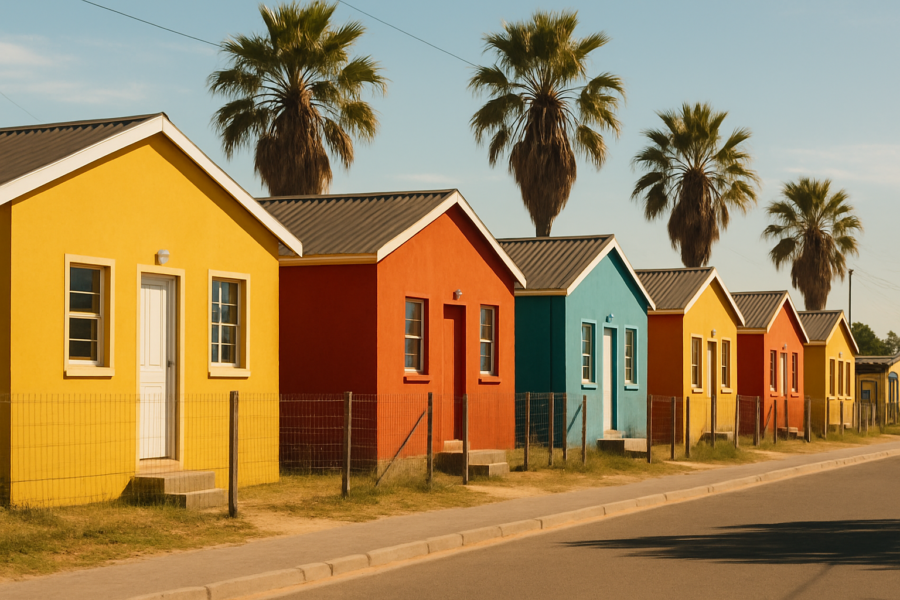
The government of South Africa offers direct housing support to its citizens via multiple initiatives — ranging from completely subsidised complimentary homes to deposit grants that help make mortgage loans more accessible. If you hold South African citizenship and have never been a property owner, chances are there is an initiative tailored to your earnings level.
This resource explains all essential information regarding government housing in South Africa: eligibility criteria, what benefits you obtain, your entitlements as a recipient, and the vital errors you must avoid.
Consult the official Department of Human Settlements website for current information.
Visit DHS Official SiteYou will be redirected to another siteKnowing Your Entitlements as a Housing Recipient
Government housing in South Africa represents more than assistance — it constitutes a constitutional entitlement. Section 26 of the Constitution declares that every person possesses the right to proper housing, and the government must implement reasonable actions to progressively achieve this entitlement. Here is how that applies practically for initiative recipients:
Property entitlements (RDP/BNG)
Upon receiving an RDP or BNG residence, you gain legal ownership. The property gets registered under your name at the Deeds Office, and you obtain a title deed. This is not a rental arrangement or tenancy agreement — it represents complete ownership, identical to having bought the property independently.
Nevertheless, ownership includes a vital limitation: you cannot sell, lease, or transfer the property for eight years following the transfer date. This pre-emptive condition guarantees the residence fulfils its intended purpose of delivering lasting shelter. Following eight years, you may sell at current market rates.
What occurs if you never obtained your title deed?
Millions of RDP recipients continue lacking formal title deeds because of administrative delays. Without a title deed, you cannot lawfully sell the property, utilise it as security for financing, or guarantee it transfers to your beneficiaries via your estate. The government conducts title deed restoration campaigns — reach out to your provincial Department of Human Settlements to verify if this affects you.
Your entitlement to quality standards
Subsidised residences must satisfy the National Building Regulations and NHBRC (National Home Builders Registration Council) requirements. If your residence exhibits structural problems — fractured walls, leaking roofing, defective plumbing — you possess the entitlement to request repairs. Submit defect reports to your municipal housing authority and the NHBRC warranty initiative.
Earnings Categories: Which Initiative Applies to You?
The primary determining element in establishing which housing initiative you qualify for is your total household earnings — the combined gross monthly income of all individuals residing in your household.
- R0 – R3,500/month: RDP/BNG complimentary housing. You contribute nothing. The government constructs and transfers a residence to you.
- R3,501 – R22,000/month: FLISP subsidy. You secure a mortgage loan, and the government provides a deposit subsidy between R38,878 and R169,264.
- R1,500 – R15,000/month: Social Housing (rental). You contribute subsidised rent in a managed housing facility within a designated metropolitan area.
- Above R22,000/month: No government subsidy obtainable. You access housing via the private sector.
Observe that the FLISP and Social Housing earnings ranges intersect. If you earn between R3,501 and R15,000, you might potentially qualify for both — however FLISP provides you ownership, whereas Social Housing constitutes rental. For most individuals in this category, FLISP represents the superior long-term choice if you can secure a mortgage loan.
Common Errors and How to Prevent Them
Managing the housing system is not always simple. These represent the most common problems applicants and recipients encounter:
1. Submitting applications at the incorrect location
RDP/BNG applications are processed via your local municipality — not a provincial or national department. FLISP applications are processed via your bank or the NHFC. Submitting through the incorrect channel generates delays and confusion.
2. Failing to retain copies of your documentation
Always retain photocopies of everything you submit. Municipal departments process thousands of applications, and documentation can be misplaced. Your copies constitute your evidence that you submitted an application.
3. Compensating intermediaries
This bears repeating: housing applications are complimentary. No authentic government official or representative will ever demand payment. If anyone requests money, they are perpetrating fraud. Report them to the Anti-Corruption Hotline: 0800 701 701.
🇿🇦
SA Housing Programmes at a Glance
Find the right programme for your income level
RDP / BNG — Free Housing
Income up to R3,500/mo. Fully government-built home transferred to you at no cost. Apply at your municipal housing office.
FLISP — First Home Finance Subsidy
Income R3,501–R22,000/mo. Once-off subsidy (R38,878–R169,264) for your home loan deposit. Apply through your bank or NHFC.
Social Housing — Subsidised Rental
Income R1,500–R15,000/mo. Below-market rental in designated urban zones. Managed by SHRA-accredited institutions.
Emergency Housing
Temporary shelter for disaster victims, fire, floods, or evictions. Contact your local municipality.
All applications are free. Never pay anyone to apply on your behalf.
4. Selling during the 8-year restriction
Selling an RDP/BNG residence within eight years of obtaining it is unlawful. Unofficial sales contracts during this timeframe provide no legal safeguards to either side. If you must relocate during the restriction timeframe, reach out to your municipal housing authority to explore your alternatives — do not pursue unofficial sale transactions.
5. Neglecting to follow up
Applications can remain in the system for years. Verify your status regularly via the Housing Subsidy System (HSS) or by visiting your municipal housing authority. If your contact information changes, update it promptly — if the department cannot contact you when your name appears, you risk forfeiting your allocation.
How FLISP Transforms the Mortgage Loan Situation
For numerous working South Africans, the greatest obstacle to homeownership is not the monthly installment — it is the deposit. Banks generally require a 10-20% deposit on a property purchase. On a R500,000 property, that represents R50,000–R100,000 in funds that most households simply lack.
FLISP removes or substantially decreases this obstacle. A household earning R8,000 monthly, for instance, could obtain a subsidy of roughly R130,000 — sufficient to cover the deposit on an affordable residence and even decrease the loan amount, reducing monthly installments.
The initiative is obtainable through all leading banks. When you request a mortgage loan, inquire with your consultant specifically regarding FLISP. Some banks maintain dedicated affordable housing divisions with consultants experienced in the initiative.
NHFC — FLISP DetailsYou will be redirected to another siteVerifying Your Application Progress
The Housing Subsidy System (HSS) constitutes the national database that monitors all housing subsidy applications throughout South Africa. Your application gets recorded on this system immediately upon capture at your municipal authority.
To verify your progress:
- Visit your municipal housing authority with your ID and request an HSS status verification
- Contact the Department of Human Settlements toll-free number: 0800 146 873
- Some provinces provide online status verification through their departmental platforms
If you submitted an application years previously and have never obtained a response, it is worthwhile verifying whether your application remains active in the system. Transitions in municipal administration can occasionally cause applications to be misplaced or deprioritised.
Your Journey to Property Ownership
South Africa’s housing initiatives have provided over 4.7 million housing opportunities since 1994. The initiatives are genuine, they receive funding, and they are actively implementing. Whether you earn R2,000 or R20,000 monthly, there exists a route to a residence with government assistance.
The most critical action is the initial one: visiting your municipal housing authority or bank, presenting your documentation, and officially entering the system. Everything else proceeds from there.
Visit DHS Official SiteYou will be redirected to another site