
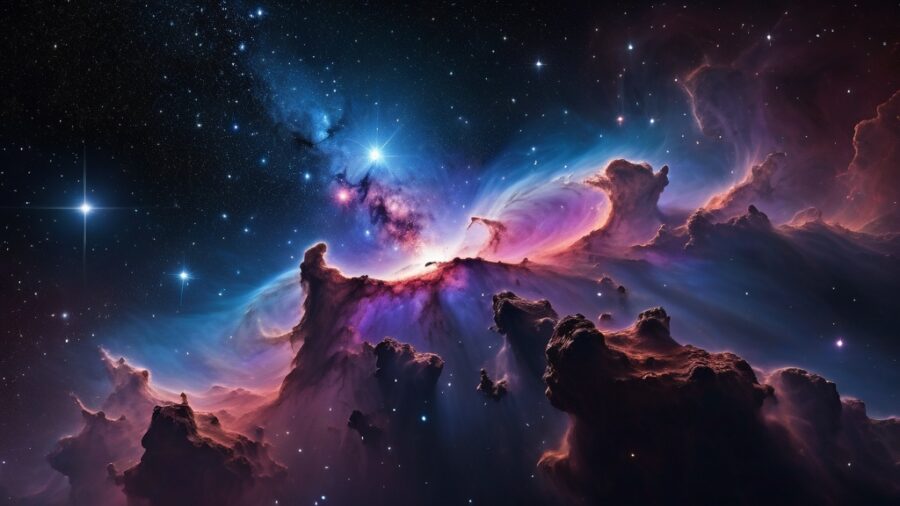
Cosmic Dawn: The Emergence of the First Stars
The term cosmic dawn refers to a pivotal period in the universe’s history when the very first stars began to illuminate the darkness of space. This era, occurring approximately 13.8 billion years ago, marks the transition from the universe’s initial formation to a phase rich in cosmic activity. Understanding this phenomenon not only enhances our knowledge of the universe’s evolution but also sheds light on the origins of galaxies, stars, and ultimately, the conditions that foster life.
This article will explore the intricacies of cosmic dawn and the first stars, delving into the theoretical frameworks that underpin this epoch, the role of the Dark Ages in star formation, the evidence supporting the existence of the first stars, and the significant impact these celestial bodies had on cosmic evolution. Furthermore, we will examine future research directions in the study of cosmic dawn, aiming to provide a comprehensive understanding of this fascinating topic.
As we journey through the cosmos, we will uncover the mysteries surrounding the formation of the first stars, their characteristics, and how they shaped the universe as we know it today. By the end of this exploration, readers will gain a deeper appreciation for the cosmic origins of our universe, grounded in scientific inquiry and discovery.
Theoretical Framework of Cosmic Dawn
1. The Big Bang and Its Aftermath
The cosmic dawn is intrinsically linked to the Big Bang, which occurred around 13.8 billion years ago. This monumental event set the stage for the universe’s expansion and cooling. Following the Big Bang, the universe was filled with a hot, dense mixture of particles, primarily protons, neutrons, and electrons. As the universe expanded, it cooled, allowing these particles to combine and form hydrogen and helium, the building blocks of the first stars.
Approximately 380,000 years after the Big Bang, the universe entered a phase known as recombination, where electrons combined with protons to form neutral hydrogen atoms. This transition led to the decoupling of matter and radiation, resulting in the release of the cosmic microwave background radiation that we can still detect today. The subsequent period, often referred to as the Dark Ages, lasted for several hundred million years and was characterized by a lack of luminous objects.
2. The Formation of Early Stars
During the Dark Ages, small fluctuations in density began to coalesce under the influence of gravity, leading to the formation of the first stars, known as Population III stars. These stars were primarily composed of hydrogen and helium, lacking metals produced in later stellar generations. Their immense mass and energy output played a crucial role in reionizing the universe, ending the Dark Ages.
Population III stars are theorized to have formed in dense regions of hydrogen gas, where gravitational collapse initiated nuclear fusion. Their lifetimes were relatively short, lasting only a few million years, but their explosive deaths as supernovae enriched the surrounding interstellar medium with heavier elements, paving the way for subsequent generations of stars and galaxies.
The Role of Dark Ages in Star Formation
1. Understanding the Dark Ages
The Dark Ages of the universe, spanning from about 380,000 years to roughly 1 billion years after the Big Bang, is a critical phase for understanding star formation. During this time, no stars or galaxies existed, and the universe was predominantly filled with neutral hydrogen gas. The lack of light made this epoch a challenging area of study, as conventional telescopes could not detect any luminous objects.
This period is essential for understanding the conditions that led to the birth of the first stars. It is believed that density fluctuations in the hydrogen gas, driven by gravitational forces, began to collapse, creating regions of high density that eventually formed stars. The properties of these early stars would be pivotal in shaping the evolution of the universe.
2. Cosmic Reionization and Its Significance
As the first stars ignited, they emitted vast amounts of ultraviolet radiation, which had profound effects on the surrounding hydrogen gas. This radiation initiated cosmic reionization, as the neutral hydrogen atoms absorbed the energy and became ionized. This process is believed to have occurred between 400 million and 1 billion years after the Big Bang, fundamentally altering the state of the universe.
Reionization not only marked the end of the Dark Ages but also allowed light to travel freely through space, enabling the formation of galaxies and clusters. The study of cosmic reionization provides insights into the nature of the first stars and their contribution to the universe’s evolution.
| Key Events in Cosmic Dawn | Timeframe (Billion Years After Big Bang) |
|---|---|
| Big Bang | 0 |
| Recombination | 0.38 |
| Dark Ages | 0.38 – 1.0 |
| Formation of First Stars (Population III) | 0.5 – 1.0 |
| Cosmic Reionization | 0.4 – 1.0 |
Evidence of the First Stars
1. Observational Techniques
Detecting the first stars in the universe is a significant challenge due to their great distance and the time it takes for their light to reach us. However, astronomers have developed several observational techniques to gather evidence of these early celestial bodies. One of the most promising methods involves using space-based telescopes like the Hubble Space Telescope and the upcoming James Webb Space Telescope (JWST).
These telescopes are equipped with advanced instruments capable of observing faint light from distant galaxies and stars. By analyzing the light spectra, astronomers can infer the composition and properties of these ancient stars. The JWST, in particular, is designed to observe the infrared spectrum, which can penetrate dust clouds and reveal hidden stars and galaxies.
2. Indirect Evidence of Population III Stars
While direct observation of Population III stars remains elusive, astronomers have found indirect evidence supporting their existence. This includes the chemical composition of ancient stars in the Milky Way, which exhibit low metallicity, suggesting they formed from primordial gas enriched by Population III stars. Furthermore, the discovery of galaxies at high redshifts indicates that star formation began earlier than previously thought, aligning with the timeline for cosmic dawn.
Additionally, simulations of early galaxy formation provide insights into how these first stars would have interacted with their environment, influencing the formation of subsequent stars and galaxies. These models help bridge the gap between theoretical predictions and observational data.
Impact of First Stars on Cosmic Evolution
1. Stellar Feedback Mechanisms
The first stars had a profound impact on the evolution of the cosmos through various feedback mechanisms. Their immense energy output and supernova explosions contributed to the reionization of the universe, as previously mentioned. This process not only ionized hydrogen but also expelled heavy elements into the interstellar medium, enriching the gas that would form future generations of stars.
Furthermore, the energy released during supernovae played a crucial role in regulating star formation in their vicinity. The shock waves generated by these explosions can compress nearby gas clouds, triggering the formation of new stars. This cycle of star formation and destruction is a fundamental aspect of cosmic evolution.
2. Formation of Galaxies and Clusters
The emergence of the first stars also paved the way for the formation of galaxies and galaxy clusters. As these stars formed and exploded, they contributed to the gravitational binding of matter, leading to the clumping of gas and dark matter into larger structures. Over time, these structures evolved into the galaxies we observe today.
The distribution of galaxies throughout the universe reflects the influence of early stars, as their formation set the stage for the large-scale structure of the cosmos. Understanding the impact of the first stars on galaxy formation helps astronomers piece together the history of the universe and its eventual fate.
| Effects of First Stars on Cosmic Evolution | Mechanism |
|---|---|
| Reionization | Ultraviolet radiation ionizes hydrogen gas |
| Enrichment of Interstellar Medium | Supernovae release heavy elements |
| Regulation of Star Formation | Shock waves compress gas clouds |
| Galaxy Formation | Gravitational clumping of matter |
Future Research Directions in Cosmic Dawn Studies
1. Advancements in Observational Technology
The study of cosmic dawn is entering an exciting era with advancements in observational technology. The James Webb Space Telescope, set to revolutionize our understanding of the early universe, will allow astronomers to probe deeper into the cosmos than ever before. Its capabilities to observe in infrared wavelengths will provide unprecedented insights into the formation and evolution of the first stars and galaxies.
In addition to JWST, ground-based observatories like the Extremely Large Telescope (ELT) will enhance our ability to study distant galaxies, potentially detecting light from the first stars. These advancements will enable researchers to gather more data, refine models of star formation, and test theoretical predictions against observational evidence.
2. Theoretical Models and Simulations
Future research will also focus on refining theoretical models and simulations of cosmic dawn. Current models are based on a combination of observational data and simulations that aim to replicate the conditions of the early universe. As new data becomes available, particularly from upcoming telescopes, these models can be adjusted to provide a more accurate depiction of star formation processes.
Researchers will also explore the role of dark matter in the formation of the first stars and galaxies, seeking to understand how gravitational interactions influenced early cosmic structures. This multifaceted approach will enhance our comprehension of cosmic dawn and its significance in the broader context of cosmic evolution.
Conclusion: Understanding Our Cosmic Origins
The concept of cosmic dawn and the formation of the first stars represent a crucial chapter in the story of our universe. As we have explored, this period was marked by significant events that shaped the cosmos, from the birth of the first stars to the complex interactions that led to galaxy formation.
Through advancements in observational technology and theoretical models, we are on the cusp of unlocking further mysteries surrounding cosmic dawn. The journey to understand our cosmic origins is ongoing, and each discovery adds a new layer to the intricate tapestry of the universe.
Ultimately, the study of cosmic dawn not only enhances our understanding of the universe’s history but also our place within it. As we continue to explore the cosmos, we inch closer to answering fundamental questions about existence, life, and the nature of the universe itself.
FAQ about Cosmic Dawn and Early Stars
1. What is cosmic dawn?
Cosmic dawn refers to the period in the universe’s history when the first stars began to form and illuminate the cosmos. This era occurred approximately 13.8 billion years ago, marking the transition from a dark universe to one filled with light and activity.
2. How did the first stars form?
The first stars, known as Population III stars, formed from primordial hydrogen and helium gas in regions of high density. Gravitational forces led to the collapse of these gas clouds, igniting nuclear fusion and creating the first luminous objects in the universe.
3. What role did the Dark Ages play in star formation?
The Dark Ages, which lasted from about 380,000 to 1 billion years after the Big Bang, was a period devoid of stars and galaxies. It set the stage for star formation by allowing density fluctuations in hydrogen gas to coalesce, eventually leading to the birth of the first stars.
4. What evidence do we have of the first stars?
While direct observation of Population III stars is challenging, astronomers have found indirect evidence through the chemical composition of ancient stars and the discovery of high-redshift galaxies. These data suggest that the first stars played a significant role in the evolution of the universe.
5. What can we expect from future research in cosmic dawn studies?
Future research will leverage advancements in observational technology, such as the James Webb Space Telescope, and refine theoretical models of star formation. This will enhance our understanding of cosmic dawn and the processes that shaped the early universe.
Recap of Key Points
- Cosmic dawn marks the era when the first stars illuminated the universe.
- The formation of the first stars is linked to the Big Bang and the subsequent cooling of the universe.
- The Dark Ages played a crucial role in setting the stage for star formation.
- Evidence of the first stars comes from observational techniques and indirect data.
- First stars had a significant impact on cosmic evolution through reionization and stellar feedback.
- Future research will focus on advanced observational technologies and refined theoretical models.
- Understanding cosmic dawn enhances our knowledge of the universe’s origins and evolution.