
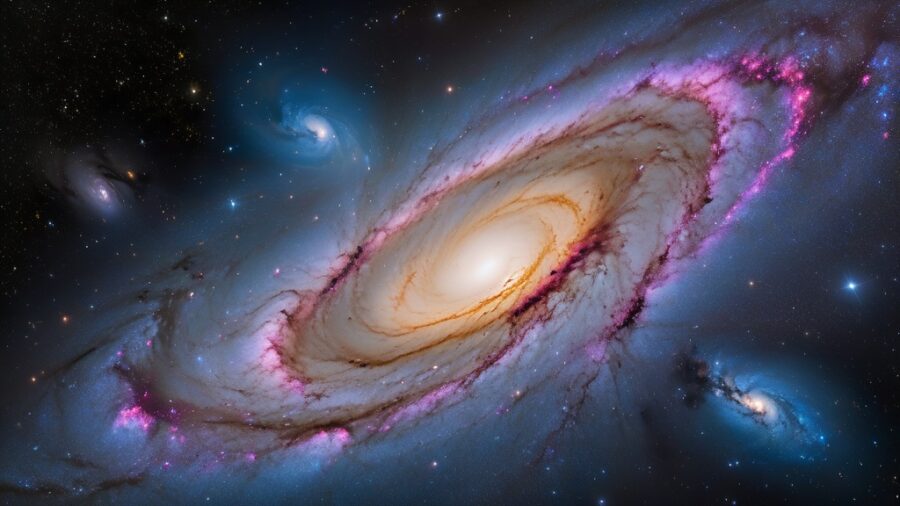
Galactic Center of the Milky Way: An In-Depth Exploration
The galactic center of the Milky Way is a fascinating region that has captured the attention of astronomers and astrophysicists worldwide. As the heart of our galaxy, this area is not only a source of immense gravitational forces but also a rich tapestry of stellar formations, cosmic events, and mysteries waiting to be unraveled. In this article, we will delve into the intricacies of the galactic center, exploring its structure, significant discoveries, and the technologies that allow us to investigate its depths.
Understanding the galactic center is crucial for comprehending the larger cosmic framework in which our galaxy exists. It serves as a laboratory for studying phenomena that cannot be replicated on Earth. From the role of black holes to the implications of dark matter, the galactic center offers insights that challenge our understanding of physics and the universe. Throughout this article, readers will learn not just about the galactic center itself, but also about its significance in the broader context of cosmology and future scientific explorations.
As we embark on this journey through the galactic center of the Milky Way, we will outline key discoveries and the ongoing research efforts that promise to deepen our understanding. With advancements in observational technologies, we are on the verge of uncovering more secrets hidden within this celestial realm. Let’s begin our exploration by understanding what constitutes the galactic center itself.
Introduction to the Galactic Center
Definition and Location
The galactic center refers to the central region of the Milky Way galaxy, located approximately 26,000 light-years from Earth in the direction of the constellation Sagittarius. This location is not merely a point in space; it is a dynamic and complex environment filled with stars, gas, and dust. The exact coordinates of the galactic center are roughly 17h 45m 40.04s in right ascension and -29° 00′ 28.1″ in declination.
Significance of the Galactic Center
The significance of the galactic center extends beyond its physical location. It is a region where the gravitational forces are strongest, influencing the orbits of nearby stars and gas clouds. The area is also home to the supermassive black hole known as Sagittarius A*, which has a mass equivalent to about 4.1 million solar masses. This immense gravitational pull affects not only the galactic center but also the overall structure and dynamics of the Milky Way.
The Structure and Composition of the Galactic Center
Components of the Galactic Center
The galactic center is composed of several key components, each playing a crucial role in its overall structure. These include:
- Stars: The region hosts a dense population of stars, including young, hot stars and older, cooler stars.
- Gas and Dust: The interstellar medium in the form of gas and dust is prevalent, providing the raw materials for star formation.
- Dark Matter: Although not directly observable, dark matter is believed to be present in significant quantities, influencing the gravitational dynamics of the region.
Understanding the Galactic Bulge
One of the most prominent features of the galactic center is the galactic bulge. This is a tightly packed group of stars that forms a spheroidal structure around the core. The bulge is primarily composed of older stars and contains a significant amount of gas and dust. Studies have shown that the bulge contains a mix of stellar populations, which provides insight into the history and evolution of the Milky Way.
Significant Discoveries in the Galactic Center
Observations of Sagittarius A*
One of the most groundbreaking discoveries in the galactic center is the identification of the supermassive black hole, Sagittarius A*. In the early 1990s, astronomers began observing stars orbiting an invisible mass in the center of the Milky Way. The measurements indicated the presence of a black hole with a mass of approximately 4.1 million solar masses. This discovery has significantly advanced our understanding of black holes and their role in galaxy formation.
Stellar Orbits and Dynamics
Research conducted over the past few decades has revealed fascinating insights into the orbits of stars near Sagittarius A*. For instance, the star S2 orbits the black hole every 15.2 years, providing astronomers with critical data to understand the gravitational influences at play. These studies have allowed scientists to test general relativity in extreme conditions and have provided evidence supporting the existence of supermassive black holes at the centers of other galaxies.
| Star | Orbital Period (Years) | Distance from Sagittarius A* (AU) |
|---|---|---|
| S2 | 15.2 | 17 |
| S1 | 5.5 | 12 |
| S0-102 | 11.5 | 40 |
The Role of Black Holes in the Galactic Center
Supermassive Black Holes and Galaxy Formation
The presence of supermassive black holes (SMBHs) like Sagittarius A* at the center of galaxies raises intriguing questions about their formation and evolution. Current theories suggest that SMBHs grow over time through the merging of smaller black holes and the accretion of surrounding gas and stars. This process not only influences the black hole itself but also plays a significant role in shaping the host galaxy.
Impact on Star Formation
Research indicates that the activity of supermassive black holes can have profound effects on star formation within their host galaxies. The energy and radiation emitted during accretion events can heat surrounding gas, preventing it from collapsing into new stars. This process, often referred to as feedback, can regulate star formation rates and influence the overall evolution of the galaxy.
Observational Technologies Used to Study the Galactic Center
Telescopes and Instruments
Advancements in observational technologies have revolutionized our understanding of the galactic center. Ground-based observatories, such as the Very Large Telescope (VLT) in Chile, and space-based telescopes like the Hubble Space Telescope have provided unprecedented views of this region. These instruments allow astronomers to collect data across various wavelengths, including infrared, visible, and radio waves, enabling a comprehensive analysis of the galactic center.
Radio Astronomy and Interferometry
Radio astronomy, particularly the use of interferometry techniques, has become essential for studying the galactic center. The Event Horizon Telescope (EHT), which captured the first image of a black hole’s event horizon in 2019, is an example of how these technologies can be applied to the study of Sagittarius A*. By linking multiple radio telescopes across the globe, researchers can achieve high-resolution images that reveal the structure and dynamics of this enigmatic region.
The Importance of the Galactic Center in Cosmology
Understanding Galactic Evolution
The galactic center is pivotal in understanding the evolution of galaxies, including our own Milky Way. Studies of the galactic center can inform scientists about the processes of galaxy formation, mergers, and the role of dark matter. Insights gained from this region can also help in comprehending the characteristics of other galaxies across the universe.
Cosmological Implications
Research at the galactic center has broader cosmological implications, particularly regarding the nature of dark energy and the fate of the universe. Understanding the interactions between black holes and their host galaxies can shed light on the fundamental forces driving cosmic evolution. Furthermore, studying the distribution of dark matter in the galactic center provides clues about its behavior on cosmic scales.
Future Research and Discoveries
Upcoming Missions and Projects
As technology continues to advance, numerous upcoming missions and projects aim to deepen our understanding of the galactic center. For instance, the James Webb Space Telescope (JWST), set to launch in late 2021, will provide unprecedented infrared observations of the galactic center. This mission is expected to enhance our knowledge of star formation and the interactions between stars and the supermassive black hole.
Potential Discoveries
Future research may uncover new phenomena within the galactic center, including previously undetected black holes, exotic stellar objects, or new forms of dark matter. The ongoing studies of stellar orbits and gas dynamics will likely yield new insights into the gravitational influences at play. As we develop more sophisticated observational techniques, our understanding of this region will continue to evolve.
Conclusion
The galactic center of the Milky Way is a complex and dynamic region that offers invaluable insights into the nature of galaxies, black holes, and the universe as a whole. From the pivotal role of Sagittarius A* as a supermassive black hole to the intricate interactions between stars and gas, this area serves as a focal point for astronomical research. Understanding the galactic center is not only crucial for comprehending our own galaxy but also for shedding light on the fundamental processes that govern cosmic evolution.
As we look to the future, advancements in observational technologies promise to reveal even more secrets hidden within the galactic center. The ongoing exploration of this region will undoubtedly lead to exciting discoveries that challenge our current understanding and reshape our perspective on the cosmos.
FAQ about the Galactic Center of the Milky Way
1. What is Sagittarius A*?
Sagittarius A* is the supermassive black hole located at the center of the Milky Way galaxy. It has a mass of approximately 4.1 million solar masses and is surrounded by a dense cluster of stars and gas.
2. How far is the galactic center from Earth?
The galactic center is approximately 26,000 light-years away from Earth, situated in the direction of the constellation Sagittarius.
3. Why is the galactic center important for cosmology?
The galactic center provides critical insights into the formation and evolution of galaxies, the dynamics of black holes, and the behavior of dark matter, contributing to our understanding of the universe’s structure.
4. What technologies are used to study the galactic center?
A variety of technologies are employed to study the galactic center, including ground-based telescopes like the Very Large Telescope and space telescopes such as the Hubble Space Telescope. Radio astronomy techniques, including interferometry, are also crucial.
5. What are the future prospects for research at the galactic center?
Future research will likely focus on uncovering new phenomena, enhanced observations through missions like the James Webb Space Telescope, and deeper investigations into the interactions between stars and the supermassive black hole.
Recap of Key Points
- The galactic center of the Milky Way is located approximately 26,000 light-years from Earth.
- Sagittarius A* is the supermassive black hole at the heart of our galaxy.
- The region is composed of a dense population of stars, gas, and dust, with significant dark matter presence.
- Research has revealed the dynamics of stellar orbits around Sagittarius A*, providing insights into gravitational influences.
- Advancements in observational technologies are critical for ongoing research and discoveries in the galactic center.
- The galactic center plays a crucial role in understanding galaxy formation, evolution, and cosmological implications.
- Future missions, such as the James Webb Space Telescope, promise to enhance our knowledge of this enigmatic region.