
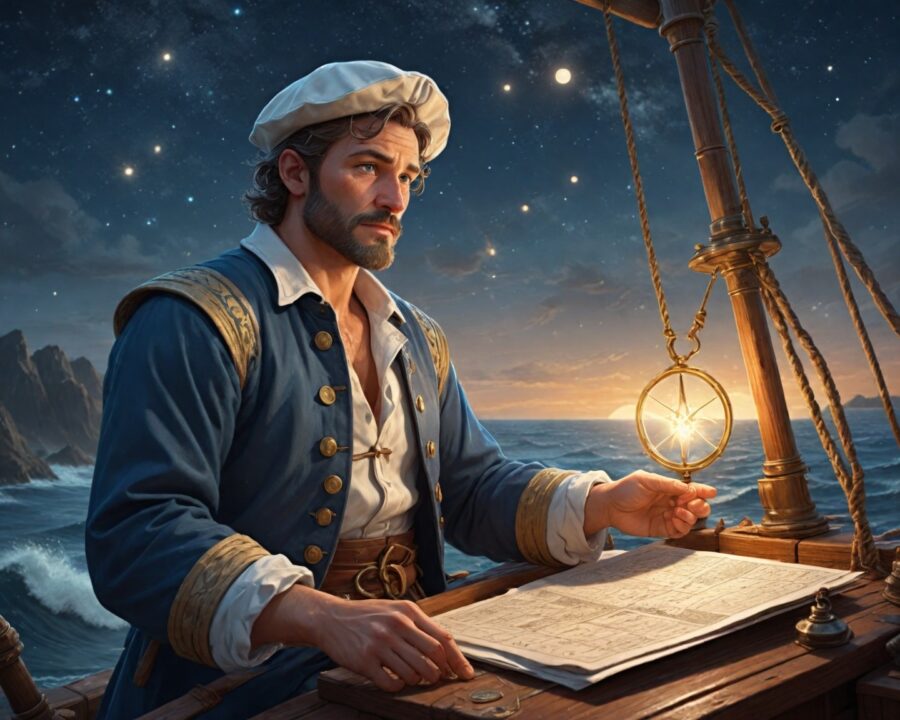
Introduction to Ancient Navigation Methods
Before the advent of modern technology, ancient sailors relied on the limited tools available to them and their knowledge of the natural world to navigate the seas. Lacking the GPS systems and digital maps we take for granted today, these seafarers had to employ a variety of methods to chart their courses and find their way across vast bodies of water. This included the use of the stars, wind patterns, and ocean currents, as well as basic navigational instruments like the astrolabe or sextant. Understanding how these intrepid explorers operated provides insight into how they mastered one of humanity’s earliest forms of travel.
Another tool at their disposal, albeit less scientific, was mythology. Myths—deeply ingrained in many ancient cultures—served as a narrative framework for understanding the world and its mysteries. These tales were often intertwined with observations of nature and the cosmos, making them useful to sailors who were trying to comprehend and predict their surroundings. By blending myth and reality, sailors could interpret these stories in ways that assisted with navigation, making mythology an essential component of their seafaring adventures.
Role of Mythology in Ancient Cultures
Mythology played a central role in nearly every ancient culture across the globe. These stories preserved historical events, explained natural phenomena, and offered moral lessons. They were passed down through generations, evolving over time while maintaining core truths about the perceptions of ancient peoples. In societies as geographically diverse as the Greeks, Polynesians, and Norse, myths were used not only to entertain but also to educate.
For ancient Greeks, myths were closely connected with the natural world. Deities and legendary figures were associated with various aspects of nature, such as the ocean, stars, or winds. For example, Poseidon was revered as the god of the sea, and tales about him were recounted by sailors to both pay homage and seek protection during their voyages. Similarly, in Polynesian culture, the ocean was at the heart of life, and navigational knowledge was often couched within stories about great voyaging canoes and mythical ancestors.
The reliance on mythology was not restricted to a form of storytelling. It was a way to explain those things that were beyond scientific understanding at the time. Myths often transformed into more than just tales; they became guiding principles that encapsulated empirical observations of the natural world, allowing sailors to translate them into practical navigation tips.
How Sailors Interpreted Myths for Navigation
Sailors found innovative ways to interpret and utilize myths for navigational purposes. They looked to mythology to understand celestial phenomena and to provide guidance on their journeys. For instance, mythic narratives would describe the positioning of stars or constellations, transforming these stories into a celestial map of sorts, particularly useful during night voyages.
The Greeks, for example, used the myth of Orion, a giant huntsman placed among the stars by Zeus, to navigate at night. The constellation Orion appears prominently from late fall to early spring and served as a reference point for ancient seafarers, assisting them in orienting their paths. The sailors’ interpretation of such myths enabled them to relate complex astronomical observations to their real-world applications.
Moreover, sailors used myths to attribute behaviors or changes in natural elements to specific gods or legendary events, lending predictability to otherwise unpredictable scenarios. For instance, if a sailor noticed a sudden change in the wind or sea conditions, the myths would offer narratives that effectively ‘predicted’ such changes, which were then integrated into navigational lore.
Examples of Mythological References in Navigation
Across different cultures, there are numerous examples of how myths were directly leveraged for navigation. Greek mythology was virtually inseparable from maritime practices, while the Polynesians, Vikings, and other seafaring peoples also effectively assimilated mythological tales into their navigation techniques.
-
Polynesian Voyaging Stories: The Polynesians used myths about the ancestral deity Maui who “fished up” islands, which inspired knowledge of island chains connected by water passages. Such stories directed their deliberate exploration of Pacific Ocean routes.
-
The Greek Argo: The story of Jason and the Argonauts and their quest for the Golden Fleece is a myth that contains geographical references and hints of the Periplus, or a voyage log, which sailors could have used as an ancient nautical map of the Black Sea.
-
Norse Mythology’s World Tree: Yggdrasil, the World Tree, is another mythological motif which, besides embodying the cosmos, metaphorically described the interconnectedness of distant lands and oceans, guiding Vikings in their extensive voyages across the North Atlantic.
These myths served both as a compass for physical exploration and a spiritual anchor for the seafarers who risked their lives at sea.
The Connection Between Myths and Celestial Navigation
The connection between myths and celestial navigation is particularly strong and revealing. Celestial navigation is the art of steering by the stars—a skill developed concurrently with the sharing of stories about the constellations throughout history.
In many cultures, constellations were brought into being through myths. The Greeks, for instance, populated the skies with figures from their mythological lore, such as the hero Perseus, the chained maiden Andromeda, and the flying horse Pegasus. Such stories gave environmental meaning to otherwise random star patterns, providing sailors with a means to navigate by these “landmarks” in the sky.
Celestial mythologies transformed the night sky into a navigational toolset. By learning the relationship between certain stars, their rise and set times, and their positions in relation to one another, sailors could chart courses across vast stretches of open water. The myths associated with these celestial bodies effectively became mnemonic devices aiding in the memorization and repeated application of crucial navigational information.
Common Myths Used by Sailors Across Cultures
There are numerous myths shared by sailors from different cultural backgrounds that show how these narratives became universally crucial elements of navigation.
-
Orion and the Pleiades: Both of these stellar groups were widely utilized among ancient sailors. The Pleiades star cluster was especially critical, marking time throughout the farming year as well as guiding navigation with its appearance and disappearance in seasonal cycles.
-
The Southern Cross: In the Southern Hemisphere, the Southern Cross constellation assumed a role similar to that of the North Star in the Northern Hemisphere. Indigenous cultures in Australia and the South Pacific incorporated the Southern Cross into their navigation myths.
-
Ursa Major and the North Star: In the Northern Hemisphere, sailors frequently relied on these celestial markers. Ursa Major, also known as the Big Dipper, points towards the North Star, guiding sailors north or south depending on the hemisphere.
These common celestial myths demonstrated that regardless of the specific cultural context, sailors globally sought ways to understand and predict their environment for safe and successful seafaring.
Challenges Faced by Sailors Relying on Myths
While myths were invaluable resources, they were not infallible. Sailors experienced numerous challenges when relying on these narratives for navigation. Myths could be subject to misinterpretation, leading to dangerous miscalculations on the sea. Moreover, variations in stories or their loss over time meant that the reliability of these navigational elements could sometimes be questionable.
Weather was an unpredictable factor often easier to mythologize than to predict accurately. While associating weather phenomena with mythological characters could bring an element of order to chaos, it did not always help sailors avoid storms or navigate through them. Without reliable meteorological tools, this dependence on myths sometimes resulted in misinformation that could lead sailors astray.
Additionally, the shifting of constellations over millennia meant that some mythological descriptions no longer perfectly aligned with the positioning of celestial bodies. This celestial drift had to be accommodated by recalibrating myths over generations, complicating oral traditions with necessary updates and reinterpretations.
Modern Perspectives on Ancient Navigation Myths
Modern historians and astronomers have examined ancient navigation myths with scientific rigor, parsing stories to rediscover how past peoples interacted with their world. By dissecting these tales, scholars glean insights into how myths functioned as encyclopedias of navigational knowledge embedded within cultural contexts.
There is a growing appreciation for the ingenuity of ancient sailors who employed myths as tools to accompany their profound understanding of the natural world. While not scientifically rigorous by today’s standards, these myths represented an early form of experiential learning and empirical observation. Modern perspectives see these stories as living repositories echoing ancient knowledge and foster renewed respect for such intricate methods.
Moreover, the blending of scientific exploration with mythological study continues to inspire contemporary approaches to education and storytelling. Reconstructing these processes enriches our modern understanding of cultural heritage and illustrates the profound cognitive leaps made by early navigators.
Lessons from Ancient Sailors for Modern Navigation
Today’s navigators can learn several lessons from ancient sailors who used myths to navigate the seas. First is the importance of cultural context in complementing scientific inquiry. Stories and myths can be valuable resources in forming a holistic understanding of environments.
Second, adaptability remains essential. Ancient sailors constantly negotiated between myth and reality, adapting stories to ever-changing conditions—a practice as vital now as it was then. Innovative thinking and the ability to integrate different knowledge systems are attributes with enduring value.
Awareness and respect for the natural world also stand out as lessons. Modern navigators may look to historical precedence, appreciating how myths fostered understanding and ecological balance between environment and humanity. By revisiting these ancient principles, today’s society can cultivate more sustainable relationships with the seas and beyond.
Conclusion: The Enduring Legacy of Myths in Navigation
Myths have consistently proven to be more than mere stories—they are foundational elements that sustain cultures and promote a more profound understanding of the world. Despite the technological revolution and sophisticated methodologies available today, the role mythology has played in ancient navigation techniques remains a testimony to human ingenuity.
In examining how ancient sailors used myths to navigate the seas, we uncover narratives rich in information that constituted guides to understanding the universe’s rhythm and majesty. These intertwined navigational tales continue to be woven into the broader tapestry of human history, bearing lessons in patience, creativity, and adaptability.
In a world that often prioritizes empirical data and precise instruments, the human element of storytelling still endures. Myths remain an anchor, linking present and past and revealing time-honored wisdom beneath the stars—a reminder of how intertwined human history is with the vast, enigmatic sea.
FAQs
What were the primary navigation tools used by ancient sailors?
Ancient sailors primarily relied on natural elements such as the stars, wind, and ocean currents for navigation. They also used simple tools like the astrolabe or kamal, which helped them gauge the height of stars above the horizon to determine latitude.
How did mythology help ancient sailors on their voyages?
Mythology offered visualizations of the sky by embedding stars and planets within storytelling, thus providing navigational cues. These stories also served as mnemonic devices, helping sailors remember crucial astronomical data and predict natural events.
What are some examples of mythological constellations used for navigation?
Constellations such as Orion, Ursa Major, and the Southern Cross were central figures in various mythologies used by sailors across different cultures. These constellations offered reliable reference points for navigation throughout different seasons.
Did all ancient cultures use astronomy for sailing?
While most seafaring nations employed some form of celestial navigation, the extent and complexity varied. Cultures such as the Greeks, Polynesians, and Norse developed comprehensive systems integrating both myths and empirical observations to navigate the seas.
What are the limitations of relying on myth for navigation?
Relying on myth for navigation could lead to misinterpretations and inaccuracies, especially if the stories were altered over time. Environmental conditions like sudden storms or changes in celestial patterns could also render myth-based navigation unreliable.
How can the study of ancient myths enhance modern navigation?
Studying ancient myths provides insight into the cognitive development of early human societies and showcases their resilience and creativity. It reminds modern navigators of the importance of integrating cultural history with technological advances for holistic understanding and application.
Recap
- Ancient sailors employed various methods for navigation, prominently involving myths alongside natural observations.
- Myths played a crucial role, serving as both educational tools and navigational guides.
- Different cultures, including Greeks and Polynesians, seamlessly integrated myths into navigation.
- Celestial navigation was often rooted in mythological stories depicting constellations.
- Challenges of myth-based navigation included the risk of misinterpretation and environmental unpredictability.
- Modern perspectives view ancient navigation myths as resourceful and consequential.
- Lessons from these ancient methods include adaptability, integration of cultural context, and environmental awareness.
Concluding, myths have sustained their relevance in navigation by connecting humanity with the cosmos, fostering understanding, and imparting enduring navigational wisdom inherently steeped in narrative beauty.