
The universe has always been a source of eternal curiosity and intrigue. As mankind stands on the brink of making some of the most groundbreaking astronomical discoveries, the launch and deployment of the James Webb Space Telescope have opened new doors to understanding the cosmos. This state-of-the-art telescope, often hailed as the most sophisticated instrument of its kind, promises to revolutionize our knowledge of galaxies, stars, and other celestial phenomena. Named after a former administrator of NASA, the James Webb Space Telescope (JWST) is poised to delve deep into the vast cosmic mysteries, far beyond the capabilities of its predecessors.
The James Webb Space Telescope stands as a testament to human ingenuity and scientific advancement. It is an engineering marvel, specifically designed to explore the universe in unprecedented detail. From studying the formation of stars and planets to examining the origins of the earliest galaxies, JWST is set to unveil the secrets of the universe that have long eluded astronomers. In this guide, we will explore how the JWST works and highlight the cutting-edge technology behind its awe-inspiring mission.
Introduction to the James Webb Space Telescope
The James Webb Space Telescope is a project of enormous ambition, conceived to succeed the revolutionary Hubble Space Telescope. As of October 2023, the JWST continues to mesmerize scientists and space enthusiasts worldwide. With a primary mirror spanning 6.5 meters in diameter, the telescope dwarfs its predecessor and allows for much greater light-collecting ability, essential for observing faint and distant phenomena in the universe.
Budgeted at approximately $10 billion, the telescope represents a collaborative effort among three space agencies: NASA, the European Space Agency (ESA), and the Canadian Space Agency (CSA). Launching in December 2021, it now sits approximately 1.5 million kilometers from Earth at the second Lagrange point (L2), a stable gravitational location that offers a clear and unobstructed view of the cosmos.
The telescope’s advanced capabilities stem primarily from its ability to observe the universe in the infrared spectrum. This key feature distinguishes it from the optical focus of the Hubble, enabling astronomers to look through cosmic dust clouds and into the heart of star-forming regions. As the JWST continues to relay a breathtaking stream of data, it nourishes hope for new insights into the very fabric of the universe.
Key Objectives and Mission Goals of the Telescope
The James Webb Space Telescope was conceived with several pivotal science objectives, each an exploration into a different aspect of cosmic history and behavior. Chief among its missions is the study of the formation and evolution of galaxies. By examining the light from the earliest galaxies that formed in the universe, the telescope can provide unprecedented insights into how galaxies change over time.
Another primary objective of JWST is to observe the formation of stars and planetary systems. Young stars and planets develop in clouds of gas and dust where visible light is unable to penetrate. JWST’s infrared technology allows it to observe these phenomena, offering insights into the processes that govern the formation of stars and subsequent solar system development.
The scope of the JWST’s mission also includes investigating the physical and chemical properties of planetary systems, including our own. It aims to examine the atmospheres of exoplanets for signs of life and gather data that could help determine the viability of such planets to host life. By answering questions about the presence of water and the composition of these atmospheres, JWST may find pivotal data regarding the potential for life beyond Earth.
How the Telescope’s Infrared Technology Works
Unlike its predecessors, the James Webb Space Telescope focuses on capturing images in the infrared spectrum. This feature is critical for several reasons. Infrared radiation is less scattered by cosmic dust, allowing astronomers to peer into regions previously obscured in optical wavelengths, like star-forming regions and the cores of galaxies.
The JWST employs instruments specialized in capturing various infrared wavelengths, giving it the versatility needed to observe a wide range of phenomena. The Near-Infrared Camera (NIRCam) is one of these crucial components, designed to detect light from the earliest stars and galaxies. Its ability to operate over a range of infrared wavelengths enables the study of both high-energy processes in distant galaxies and cooler bodies, such as exoplanets and comets.
Equally important is the Mid-Infrared Instrument (MIRI), which allows the telescope to observe colder objects in the universe. MIRI is essential for spotting newly formed stars and distant planetary systems enveloped in cosmic dust. Together, these instruments leverage the full potential of infrared observation to reveal areas of the universe previously inaccessible to us.
The Role of the Telescope’s Sunshield and Mirrors
Central to the success of the James Webb Space Telescope are its sunshield and mirrors, two innovative components that enable its advanced observational capabilities. The sunshield serves a vital purpose: it protects the telescope from the heat and light emitted by the Sun, Earth, and Moon, maintaining its crucial instruments at a temperature below 50 Kelvin (approximately -370 degrees Fahrenheit).
The sunshield is made of five thin layers of Kapton, each coated with aluminum and silicon to reflect solar radiation. Spanning the size of a tennis court, the sunshield ensures that the telescope remains cool enough to detect faint infrared signals from space without interference from its own emitted heat.
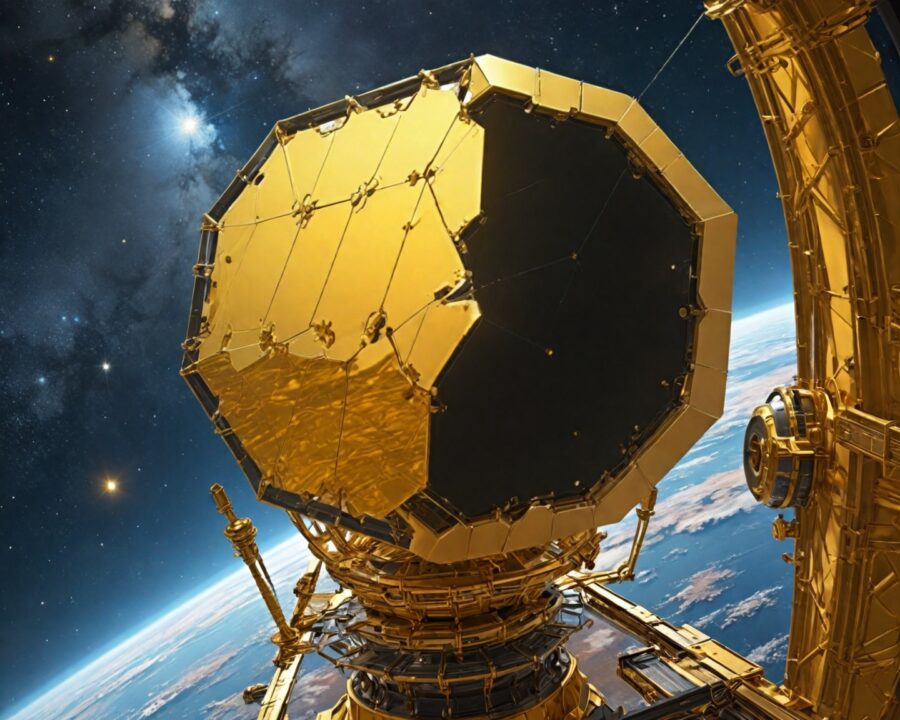
The telescope’s 18-segment primary mirror comprises beryllium and is coated with a thin layer of gold to optimize it for infrared reflection. This segmented structure allows the mirror to fold and unfold during launch and deployment, a feature designed to minimize launch volume while maximizing surface area for observing. The meticulous polishing and assembly of these mirrors allow JWST to capture incredibly detailed images and spectra from the distant universe.
How the Telescope Observes Distant Galaxies and Stars
The ability of the James Webb Space Telescope to observe distant galaxies and stars primarily depends on its infrared sensitivity and immense light-gathering capacity. By capturing the faint light emitted from the earliest galaxies, JWST extends our vision further back in time, facilitating a more thorough understanding of the universe’s infancy.
Due to the cosmic redshift, the light from these distant galaxies stretches into longer wavelengths as it travels across the universe, making them visible not in the optical spectrum but in infrared. The telescope’s ability to detect these wavelengths makes it particularly adept at observing the universe’s first galaxies, revealing their structure and composition.
Furthermore, JWST’s capabilities extend to monitoring the life cycles of stars, observing their birth, evolution, and eventual demise. It can closely examine regions of star formation, where clouds of dust and gas coalesce under gravity to form stars, providing a rare glimpse into the early phases of stellar evolution often hidden from other telescopes.
Comparison with the Hubble Space Telescope
While both the Hubble Space Telescope and JWST are powerful tools for astronomical observation, their designs and scientific missions represent different aspects of the cosmic exploration agenda. Hubble is well-known for its stunning optical and ultraviolet images of the universe, providing detailed photographs of nebulae, galaxies, and supernovae.
In contrast, the James Webb Space Telescope focuses primarily on the infrared spectrum, enabling it to study the universe’s coldest, most distant, and oldest objects. While Hubble observes the structure of nearby galaxies and supernovas in exquisite optical detail, JWST will probe deeper, into the early universe, looking for the formation of the first galaxies and identifying the processes at play during that formative period.
Moreover, JWST’s position at L2 provides a vantage point free from Earth’s interference, whereas Hubble orbits closer to our planet. This position allows JWST to maintain a stable temperature and environment, optimized for its sensitive instruments, without the need for regular servicing, setting it apart from Hubble’s experience of multiple servicing missions.
| Telescope | Primary Focus | Key Advantage |
|---|---|---|
| Hubble Space Telescope | Optical/Ultraviolet | Detailed images of nebulae and nearby galaxies |
| James Webb Space Telescope | Infrared | Observing the earliest galaxies and star-forming regions |
Challenges Faced During the Telescope’s Development and Launch
The road to deploying the James Webb Space Telescope was fraught with challenges and delays. Initially planned for a launch in 2007, the telescope’s development encountered numerous hurdles spanning technical, logistical, and financial fronts. One of its most significant challenges was the sheer complexity of its technology, including its intricate sunshield and mirror design.
Developing and testing the telescope’s components to withstand the harsh conditions of space required meticulous engineering and rigorous practices. Issues with the sunshield deployment added to the timeline, as its deployment was crucial for maintaining the extremely low operational temperatures required.
Financial constraints and budget overruns also led to scrutiny and revisions in project timelines. However, the collaboration between NASA, ESA, and CSA and their concerted efforts to resolve these challenges proved crucial to the mission’s eventual success. The precise coordination needed for its launch, especially given its complex folding mechanisms and deployment at L2, further underscored the challenges that were ultimately overcome.
Common Questions About the Telescope’s Capabilities
What makes the James Webb Space Telescope unique?
The James Webb Space Telescope’s uniqueness lies in its infrared capabilities and its large primary mirror, enabling it to observe the universe in unprecedented detail. Its position at L2 further enhances its ability to capture faint signals without interference from Earth’s reflective heat and light.
How does the sunshield help the telescope function?
The sunshield plays a critical role in protecting JWST’s instruments from solar radiation, thereby keeping them at the extremely low temperatures necessary for detecting infrared light from distant galaxies and stars.
Why is the telescope’s location at L2 important?
Placing JWST at L2 grants it a stable point in space where it can maintain optimal temperatures and minimize energy consumption needed for thermal management, allowing uninterrupted cosmic observations.
What kind of phenomena can JWST observe that Hubble cannot?
JWST can observe the early universe’s phenomena, including the first galaxies’ formation, by capturing infrared light that has been redshifted due to the universe’s expansion. This is beyond the capability of Hubble’s optical and ultraviolet observations.
How will JWST impact our understanding of exoplanets?
JWST’s advanced spectrometry capabilities allow it to study exoplanet atmospheres in detail, identifying chemical compositions and potential biomarkers that indicate the presence of water or other signs of life.
Can JWST study our own solar system?
Yes, JWST’s infrared capabilities enable it to observe cold bodies in our solar system, such as comets and asteroids, providing insights into their composition and activity.
Will there be future space telescopes after JWST?
NASA and other agencies continue to plan for future space telescopes, each addressing different scientific goals or focusing on advancing our understanding of specific cosmic phenomena, such as the Nancy Grace Roman Space Telescope slated for the 2020s.
Impact of the Telescope on Future Space Exploration
The successful deployment and operation of the James Webb Space Telescope have set new standards for future space missions, both in terms of technology and collaborative international efforts. By providing detailed observations of distant exoplanets and potentially habitable environments, JWST could answer fundamental questions about life’s existence beyond Earth, helping to map future exploratory missions.
In addition to its scientific contributions, the engineering advancements made through JWST’s development could inspire technologies for longer-term, human space exploration. Techniques for sustaining instruments in the harsh environment of space, alongside successful international collaborations, could serve as blueprints for joint missions to come.
Moreover, data from JWST will inevitably guide the direction of future telescopes, influencing the design and focus of forthcoming astronomical observatories, thereby shaping the broader trajectory of space exploration in coming generations.
How to Stay Updated on the Telescope’s Discoveries
For those interested in staying current with the James Webb Space Telescope’s discoveries, there are multiple channels to consider:
- Follow NASA’s official social media accounts and websites, which provide regular updates and images captured by the telescope.
- Subscribe to newsletters from scientific journals that routinely publish findings and analyses based on JWST data.
- Attend virtual or live talks hosted by astronomical societies and institutions where scientists frequently discuss JWST-related breakthroughs.
Recap
The journey of the James Webb Space Telescope, from its conception to its deployment, represents a monumental leap forward in space exploration. Designed to unlock the secrets of the universe with its unprecedented infrared capabilities, JWST explores the early universe, examines distant galaxies, and probes for signs of life on exoplanets. Its development, while challenging, has set a new benchmark for international cooperation and scientific ambition.
Conclusion
The James Webb Space Telescope ushers in a new era of astronomical discovery. By chronicling the birth of stars and galaxies in the early universe, JWST opens our eyes to the origins of cosmic structures that define our existence. Its innovative technology, from sunshield to mirrors, facilitates this endeavor by harnessing cutting-edge engineering for visionary science.
As JWST continues to explore the universe’s mysteries, it symbolizes the unwavering human quest for knowledge. Its findings could change the fundamental ways in which we view our cosmos, inspiring new narratives and hypotheses about the nature of space and time. With every image and data point it transmits back to Earth, the telescope invites us to embark on a shared discovery journey, fundamentally expanding what we know about our universe.
In essence, the James Webb Space Telescope stands not just as a successor to Hubble but as a trailblazer leading us deeper into the cosmos, promising to elevate our understanding of the universe to unparalleled heights.