
Understanding Stellar Evolution: The Star Lifecycle
The concept of stellar evolution is a fundamental aspect of astrophysics that explains how stars develop and change over time. It encompasses the entire lifecycle of a star, from its birth in a nebula to its eventual demise as a black hole or neutron star. In this article, we will delve into the intricate processes involved in stellar evolution, providing a comprehensive overview that will enhance your understanding of the universe. By the end of this discussion, you will grasp the significance of each phase in a star’s lifecycle and appreciate the beauty of cosmic transformations.
The lifecycle of a star is not just a scientific curiosity; it plays a vital role in the formation of galaxies, the synthesis of elements, and the overall dynamics of the universe. Every star we see in the night sky has undergone a unique journey and contributes to the complex tapestry of cosmic events. Understanding this journey will illuminate the processes that govern our universe and highlight the interconnectedness of celestial phenomena.
In the following sections, we will explore the various stages of stellar evolution, beginning with the birth of stars from nebulae and protostars. We will then examine the main sequence phase, where stars spend the majority of their lifetimes, followed by their transition to red giants and supernovae. Finally, we will discuss the end stages of stellar evolution, including neutron stars and black holes, and conclude by considering the broader implications of these processes in the universe.
The Birth of Stars: Nebulae and Protostars
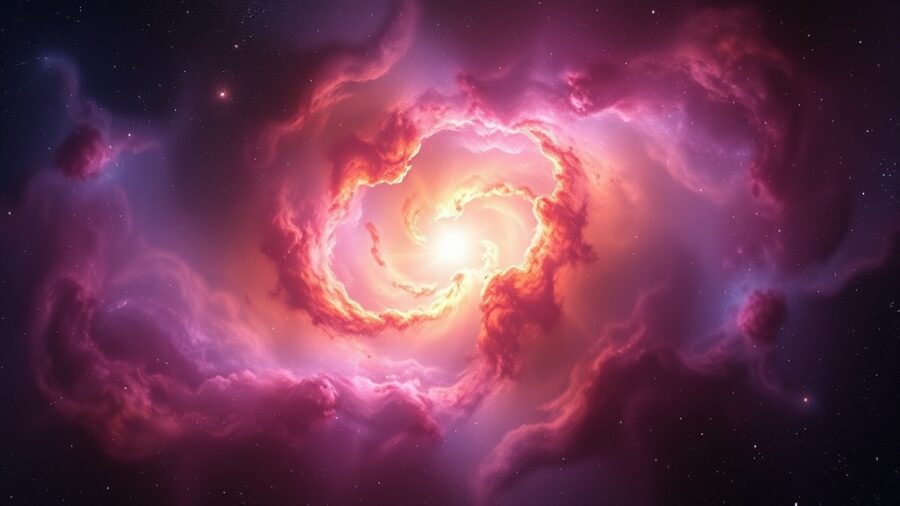
The birth of stars occurs in regions known as nebulae, which are vast clouds of gas and dust in space. These nebulae are primarily composed of hydrogen, helium, and other trace elements, and they serve as the primary material from which stars are formed. The process begins when a portion of a nebula becomes dense enough to collapse under its own gravity, leading to the formation of a protostar. This initial stage marks the beginning of a star’s lifecycle.
Nebulae: The Cradle of Stars
Nebulae are often categorized into different types, including emission, reflection, and dark nebulae. Each type plays a crucial role in stellar formation. For instance, emission nebulae are regions where gas ionizes due to the radiation from nearby hot stars, often leading to the formation of new stars. Examples include the Orion Nebula, which is approximately 1,344 light-years away from Earth and is a prolific star-forming region.
Protostars: The Formation Process
As the dense region within a nebula collapses, it begins to heat up due to gravitational forces, forming a protostar. During this phase, the protostar is surrounded by a rotating disk of gas and dust, known as an accretion disk. The temperature and pressure in the core of the protostar continue to rise until nuclear fusion reactions commence, marking the transition from a protostar to a main sequence star. This process can take millions of years, and many protostars are still in this stage today.
Main Sequence Stars: The Longest Phase
Main sequence stars are the most common type of stars in the universe, accounting for approximately 90% of the total stellar population. This phase is characterized by the nuclear fusion of hydrogen into helium in a star’s core, generating energy that counteracts gravitational collapse. Main sequence stars exist in a state of hydrostatic equilibrium, where the inward pull of gravity is balanced by the outward pressure from nuclear fusion.
The Life Cycle of a Main Sequence Star
Main sequence stars can vary significantly in size, temperature, and luminosity. The Hertzsprung-Russell diagram, a pivotal tool in astrophysics, classifies stars based on these characteristics. For example, our Sun is classified as a G-type main sequence star, with a surface temperature of about 5,500 degrees Celsius and a luminosity of one solar unit. Larger stars, such as O-type stars, can be over 100 times more massive than the Sun and burn through their hydrogen fuel at a much faster rate.
Duration and Fate of Main Sequence Stars
The duration a star spends on the main sequence depends on its mass. Smaller stars, like red dwarfs, can remain in this phase for trillions of years, while more massive stars may only last a few million years. Eventually, when hydrogen in the core is depleted, stars will leave the main sequence and undergo significant transformations, leading to their eventual demise.
Red Giants and Supernovae: The Death of Stars
The transition from the main sequence to the red giant phase occurs when a star exhausts its hydrogen fuel. As fusion ceases in the core, gravitational forces cause the core to contract, while the outer layers expand dramatically, creating a red giant. This stage is a critical moment in a star’s lifecycle, signaling the beginning of its end.
The Transformation into a Red Giant
During the red giant phase, stars undergo a series of complex processes. For instance, helium begins to fuse into heavier elements such as carbon and oxygen in the core. This fusion leads to increased energy output, causing the outer layers to expand significantly. The star’s surface temperature decreases, giving it a reddish appearance. A well-known example of a red giant is Betelgeuse, located in the Orion constellation, which is nearing the end of its lifecycle.
Supernovae: The Explosive Finale
For massive stars, the end of the red giant phase culminates in a spectacular explosion known as a supernova. This dramatic event occurs when the core collapses under gravity, and the outer layers are expelled into space at incredible speeds. Supernovae are crucial for the synthesis of heavy elements, which are dispersed into the interstellar medium, enriching future generations of stars and planets. The most famous supernova recorded was SN 1987A, which occurred in the Large Magellanic Cloud in 1987 and provided valuable insights into stellar evolution.
Neutron Stars and Black Holes: End Stages of Stellar Evolution
After a supernova, the remnants of a massive star can evolve into either a neutron star or a black hole, depending on the initial mass of the star. These objects represent the final stages of stellar evolution and are among the most extreme forms of matter in the universe.
Neutron Stars: The Compact Remnants
A neutron star is formed when the core of a massive star collapses under gravity, leading to an incredibly dense object composed primarily of neutrons. Neutron stars are typically about 20 kilometers in diameter but can have a mass greater than that of the Sun. The density is so extreme that a sugar-cube-sized amount of neutron-star material would weigh about the same as all of humanity. Pulsars, a type of neutron star, emit beams of radiation and can be observed as regular pulses of light.
Black Holes: The Ultimate Collapse
In contrast, if the remaining core mass exceeds a critical threshold (approximately three solar masses), it collapses into a black hole, a region of spacetime with gravity so strong that nothing, not even light, can escape. The boundary around a black hole is known as the event horizon. Black holes come in various sizes, with stellar black holes forming from supernova remnants and supermassive black holes found at the centers of galaxies, like Sagittarius A* in the Milky Way.
The Importance of Stellar Evolution in the Universe
The study of stellar evolution is vital for understanding the universe as a whole. It provides insights into the formation and development of galaxies, the synthesis of elements, and the evolution of planetary systems. The life and death of stars influence the chemical composition of the cosmos and play a crucial role in the lifecycle of matter.
Galactic Formation and Evolution
Stars are the building blocks of galaxies. The processes that govern stellar evolution directly impact the formation of galaxies. For instance, supernovae contribute to the creation of new stars and planets by enriching the interstellar medium with heavy elements. This cycle of birth, death, and rebirth is essential for the long-term evolution of galaxies and the universe.
The Role of Stars in Element Synthesis
Stars are fundamental to the synthesis of elements through nuclear fusion. The majority of the lighter elements, such as hydrogen and helium, were formed during the Big Bang. Heavier elements, such as carbon, oxygen, and iron, are produced in the interiors of stars and released into space during supernovae. This stellar nucleosynthesis is crucial for the formation of planets and, ultimately, life.
Conclusion
In conclusion, the lifecycle of stars from their birth in nebulae to their eventual demise as neutron stars or black holes is a fascinating journey that shapes the universe. Understanding stellar evolution not only enhances our knowledge of celestial phenomena but also underscores the interconnectedness of the universe. The processes involved in the birth, life, and death of stars are essential for the formation of galaxies, the synthesis of elements, and the overall dynamics of the cosmos.
As we continue to explore the universe, the study of stellar evolution will play a central role in our quest to understand the nature of existence and our place within it. Each star tells a story, and through these stories, we can piece together the history of the universe itself.
FAQ about Stellar Evolution
1. What is stellar evolution?
Stellar evolution refers to the processes by which stars are born, develop, and ultimately die. It encompasses various stages, including the formation of stars from nebulae, their main sequence phase, and their eventual transformation into red giants, neutron stars, or black holes.
2. How long does a star stay in the main sequence phase?
The duration a star spends in the main sequence phase varies significantly based on its mass. Smaller stars, like red dwarfs, can remain in this phase for trillions of years, while massive stars may only last a few million years before progressing to the next stage of their lifecycle.
3. What happens during a supernova?
A supernova occurs when a massive star exhausts its nuclear fuel and undergoes a catastrophic collapse, resulting in a powerful explosion that ejects the outer layers into space. This event is crucial for dispersing heavy elements throughout the universe.
4. What are neutron stars and black holes?
Neutron stars are incredibly dense remnants of massive stars that have undergone supernova explosions, composed primarily of neutrons. Black holes, on the other hand, are regions of spacetime with gravitational forces so intense that nothing can escape from them, formed from the remnants of very massive stars.
5. Why is the study of stellar evolution important?
The study of stellar evolution is crucial for understanding the formation and development of the universe. It provides insights into galaxy formation, element synthesis, and the dynamics of cosmic structures, helping us comprehend the origins of matter and the conditions necessary for life.
- Stellar evolution encompasses the birth, life, and death of stars.
- Nebulae serve as the cradles for star formation.
- Main sequence stars represent the longest phase of a star’s life.
- Red giants and supernovae mark the transition to a star’s end stages.
- Neutron stars and black holes are the ultimate fates of massive stars.
- Stellar processes are vital for the synthesis of elements in the universe.
- The study of stellar evolution helps us understand the cosmos better.
- Each star’s lifecycle contributes to the overall dynamics of galaxies.