
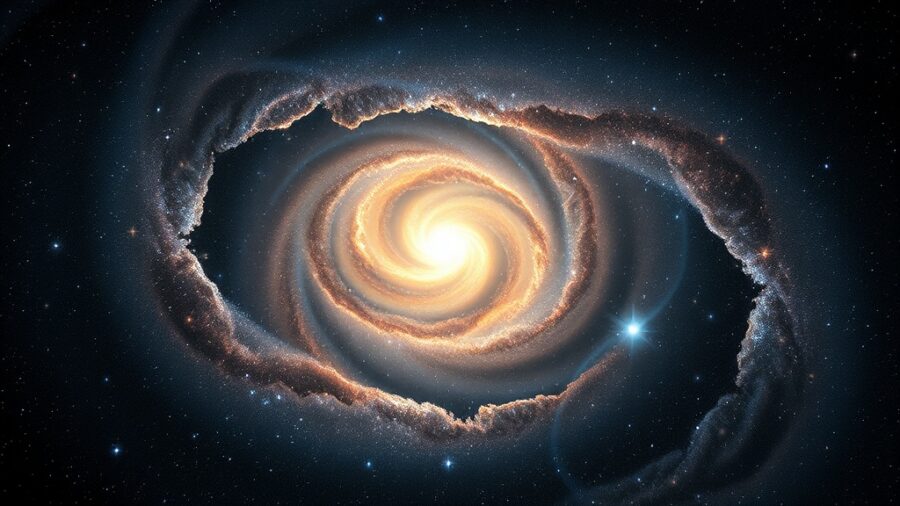
Introduction to Spiral Arms Density Waves
Spiral arms density waves are fascinating phenomena that play a crucial role in the structure and evolution of galaxies. These waves are not just simple patterns; they are complex structures that influence star formation and the dynamics of galactic environments. Understanding these density waves helps astronomers unravel the mysteries of how galaxies evolve over billions of years. In this article, we will explore the intricacies of spiral arms density waves, their formation, and their impact on the universe.
The concept of density waves was first proposed by astronomers such as Lin and Shu in the early 1960s. They suggested that the spiral arms of galaxies are not static structures but rather dynamic waves that travel through the galactic disk. As these waves move, they compress gas and dust, leading to increased star formation in certain areas. This process is essential for maintaining the vitality of galaxies and ensuring that new stars continue to emerge.
Throughout this article, we will delve into the formation mechanisms of spiral arms, the observational evidence supporting their existence, and their significant impacts on star formation. By the end, you will have a comprehensive understanding of spiral arms density waves and their role in the cosmos.
The Formation of Spiral Arms in Galaxies
The formation of spiral arms in galaxies is a complex process influenced by various factors, including gravitational interactions, the distribution of mass, and the dynamics of stellar motion. Understanding these factors is key to comprehending how spiral arms density waves manifest in different types of galaxies.
Gravitational Influence and Density Waves
At the core of spiral arm formation is the concept of gravitational influence. The gravitational pull of stars, gas, and dark matter within a galaxy creates a potential well that influences the motion of these components. When stars move through the galactic disk, they experience varying gravitational forces that can lead to the formation of density waves. These waves manifest as areas of higher density, where stars and gas are concentrated.
As stars orbit the center of the galaxy, they encounter regions of increased density, leading to gravitational interactions that can enhance the formation of spiral structures. The density wave theory suggests that these spiral arms are not fixed but rather move through the disk, allowing for continuous star formation as new material is compressed in their wake.
Role of Stellar Motion in Spiral Arm Formation
Stellar motion is another critical factor in the formation of spiral arms. As stars move in their orbits, they can interact with the density waves, leading to the formation of new stars in areas where gas is compressed. This process is often referred to as the star formation rate, which tends to peak in the regions of spiral arms due to the higher density of gas and dust.
Observations of galaxies such as the Milky Way and Andromeda have shown that young, hot stars are often found in or near spiral arms, indicating that these regions are dynamic sites of star formation. The interplay between stellar motion and density waves creates a cycle of star birth and death, contributing to the overall evolution of galaxies.
- Gravitational interactions lead to density variations.
- Stellar orbits influence the star formation rate.
- Young stars are often concentrated in spiral arms.
Density Waves: Mechanisms and Dynamics
The dynamics of density waves are governed by complex mechanisms that involve both gravitational forces and the physical properties of the interstellar medium (ISM). Understanding these mechanisms is essential for deciphering the behavior of spiral arms in different galaxies and their implications for star formation.
Mechanisms Behind Density Waves
One of the primary mechanisms that generate density waves is the self-gravity of the galactic disk. As stars and gas move through the disk, their gravitational attraction creates regions of higher and lower density. This gravitational influence can lead to the formation of a wave-like pattern, where regions of high density correspond to the spiral arms.
Additionally, external forces such as interactions with neighboring galaxies can also contribute to the formation of density waves. For example, when two galaxies collide or pass close to each other, their gravitational forces can distort their shapes, leading to the creation of new spiral structures. Such interactions are common in the universe and can significantly influence the dynamics of density waves.
Dynamics of Spiral Arms
The dynamics of spiral arms are characterized by their ability to propagate through the galactic disk. As density waves travel, they compress the gas and dust in their path, triggering star formation. This process occurs in a cyclical manner, as new stars form, age, and eventually die, contributing to the ongoing evolution of the spiral arms.
Furthermore, the spiral arms themselves can change over time. Observations suggest that the arms can evolve and may not remain stationary. This dynamism is a crucial aspect of galaxy evolution, as it influences the distribution of stars, gas, and dust across the galaxy.
| Factor | Impact on Density Waves |
|---|---|
| Gravitational Interactions | Leads to density variations and wave formation |
| Stellar Motion | Influences star formation rates |
| External Forces | Can create new spiral structures |
Observational Evidence of Spiral Density Waves
The study of spiral arms density waves is supported by a wealth of observational evidence from various astronomical surveys and imaging techniques. These observations have provided critical insights into the nature of spiral structures and their role in the evolution of galaxies.
Observations from Telescopes and Surveys
Modern telescopes, such as the Hubble Space Telescope and the Atacama Large Millimeter/submillimeter Array (ALMA), have allowed astronomers to observe spiral galaxies in unprecedented detail. These observations have revealed the presence of spiral arms and their associated density waves, providing a clearer picture of how these structures form and evolve.
For instance, ALMA has enabled scientists to study the distribution of gas and dust in spiral galaxies, revealing how density waves affect star formation. By analyzing the molecular gas distribution, astronomers can identify regions where star formation is occurring and correlate it with the locations of spiral arms.
Mapping Star Formation in Spiral Arms
One of the most compelling pieces of evidence for density waves is the mapping of star formation in spiral arms. Studies have shown that young, massive stars are predominantly found in these regions, indicating that the density waves play a crucial role in triggering star formation. Observational studies in galaxies such as the Messier 51 (Whirlpool Galaxy) have provided insights into how density waves influence the star formation process.
This mapping has also revealed that the rate of star formation tends to peak in the vicinity of spiral arms, supporting the notion that these structures are dynamic sites for the creation of new stars. Such findings have significant implications for our understanding of galaxy evolution and the lifecycle of stars.
Impacts of Density Waves on Star Formation
The impacts of spiral arms density waves extend far beyond their formation and dynamics; they play a vital role in the processes of star formation and the overall evolution of galaxies. Understanding these impacts is essential for grasping the life cycle of galaxies and the cosmic processes that govern them.
Star Formation Rates and Density Waves
Density waves significantly influence the rate of star formation within galaxies. As these waves propagate through the galactic disk, they compress gas and dust, leading to increased density in specific regions. This process enhances the likelihood of star formation, as the conditions become favorable for the collapse of gas clouds into new stars.
Statistical studies have shown that galaxies with pronounced spiral arms, such as the Pinwheel Galaxy (M101), exhibit higher star formation rates compared to those without well-defined spiral structures. This correlation underscores the critical role of density waves in fostering stellar birth across the universe.
Long-term Effects on Galactic Evolution
Over the long term, the impacts of density waves on star formation can significantly shape the evolution of galaxies. As new stars are formed in the spiral arms, they contribute to the overall mass and luminosity of the galaxy. The lifecycle of stars, including their eventual death and the formation of supernova remnants, further influences the interstellar medium and the conditions for future star formation.
This ongoing cycle of star birth and death creates a dynamic environment within galaxies, ensuring that they remain active and evolve over time. The interplay between density waves and star formation is a fundamental aspect of galactic evolution, making it a critical area of study for astronomers.
Comparative Analysis of Different Galaxy Types
Different types of galaxies exhibit varying characteristics in their spiral arms density waves, leading to fascinating comparative analyses. Understanding these differences helps astronomers categorize galaxies and gain insights into their evolutionary paths.
Spiral Galaxies vs. Elliptical Galaxies
Spiral galaxies, such as the Milky Way and Andromeda, are characterized by their well-defined spiral arms and active star formation. In contrast, elliptical galaxies tend to have a more uniform distribution of stars and lack prominent spiral structures. This difference can be attributed to the presence of density waves in spiral galaxies, which facilitate star formation, while elliptical galaxies often exhibit older stellar populations with minimal new star formation.
Studies have shown that spiral galaxies with strong density waves tend to form stars at a higher rate than their elliptical counterparts. This distinction highlights the significant impact of density waves on the evolutionary trajectories of different galaxy types.
Irregular Galaxies and Their Density Waves
Irregular galaxies, such as the Large Magellanic Cloud, present a unique case in the study of density waves. These galaxies often lack a defined spiral structure, and their star formation processes can be influenced by gravitational interactions with neighboring galaxies. Observations suggest that even in these irregular systems, density waves can form, albeit in a less organized manner than in spiral galaxies.
The irregular nature of these galaxies can lead to sporadic star formation events, influenced by external gravitational forces rather than well-defined density waves. This comparative analysis further emphasizes the diversity of galactic structures and the varying roles that density waves play in star formation across different galaxy types.
The Future of Research on Spiral Arms Density Waves
The field of research on spiral arms density waves is continually evolving, driven by advancements in observational technology and theoretical modeling. As astronomers strive to deepen their understanding of these phenomena, several exciting avenues for future research are emerging.
Technological Advancements and New Observations
With the advent of next-generation telescopes and observational techniques, astronomers are poised to gain new insights into spiral arms density waves. Instruments such as the James Webb Space Telescope (JWST) will provide unprecedented views of galactic structures, allowing researchers to study the formation and dynamics of spiral arms in greater detail.
These advancements will enable scientists to explore previously unobservable regions of galaxies, providing a more comprehensive understanding of the relationship between density waves and star formation.
Theoretical Modeling and Simulations
In addition to observational advancements, theoretical modeling and simulations will play a crucial role in shaping future research. By developing sophisticated models that incorporate the dynamics of density waves and star formation, astronomers can test hypotheses and predict the behavior of galaxies over time.
Collaborative efforts between observational astronomers and theorists will enhance our understanding of how density waves influence galactic evolution, potentially leading to new discoveries and insights into the formation of the universe.
Conclusion and Key Takeaways
In conclusion, spiral arms density waves are fundamental components of galaxy structure and evolution. They play a critical role in the formation of galaxies, influencing star formation rates and shaping the cosmic landscape. Through the study of density waves, astronomers gain valuable insights into the dynamic processes that govern galactic life.
Key takeaways from this exploration include:
- Spiral arms density waves are dynamic structures influenced by gravitational interactions.
- They significantly impact star formation rates and the overall evolution of galaxies.
- Different galaxy types exhibit varying characteristics in their spiral arms density waves.
- Future research will benefit from technological advancements and theoretical modeling.
As we continue to explore the universe, understanding spiral arms density waves will remain a vital area of inquiry, providing insights into the nature of galaxies and the processes that shape our cosmos.
Frequently Asked Questions about Spiral Arms Density Waves
What are spiral arms density waves?
Spiral arms density waves are dynamic structures in galaxies that form due to gravitational interactions and the motion of stars and gas. They influence star formation by compressing material in specific regions, leading to increased density and the birth of new stars.
How do density waves impact star formation?
Density waves significantly enhance star formation rates by compressing gas and dust, creating favorable conditions for star formation. Regions of higher density in spiral arms typically correspond to areas where new stars are actively forming.
What is the difference between spiral and elliptical galaxies?
Spiral galaxies have well-defined spiral arms and active star formation due to density waves, while elliptical galaxies lack prominent structures and typically have older stellar populations with minimal new star formation.
How do observations support the existence of density waves?
Observational evidence from telescopes like Hubble and ALMA has revealed the presence of spiral arms and correlated star formation in galaxies. Mapping the distribution of gas and young stars provides compelling support for the density wave theory.
What is the future of research on spiral arms density waves?
The future of research in this area will be driven by technological advancements in observational tools and theoretical modeling. New telescopes and simulations will enhance our understanding of the dynamics of density waves and their impact on galactic evolution.
Recap
- Spiral arms density waves are dynamic structures within galaxies.
- They significantly influence star formation processes.
- Different types of galaxies exhibit various characteristics related to density waves.
- Observational evidence supports the existence and importance of density waves.
- Future research will be shaped by advancements in technology and theoretical modeling.