
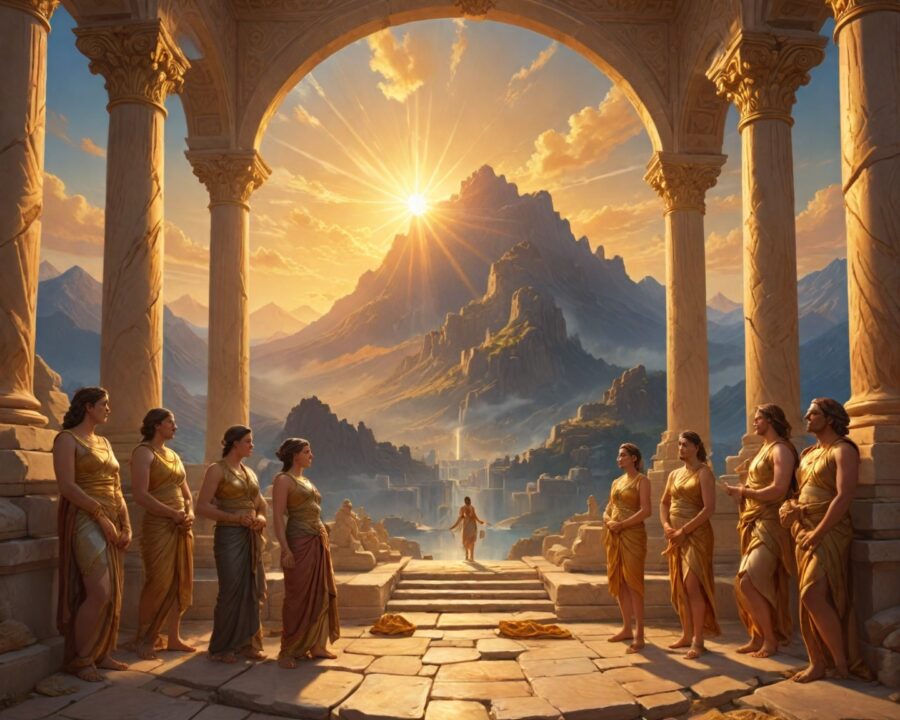
Mount Olympus, the tallest mountain in Greece, towers majestically over the landscape, stirring the imagination of those who gaze upon its peaks. This imposing presence of the natural world became a pivotal center in the spiritual and mythological life of the ancient Greeks. Revered not only as a geographical landmark but also as a divine abode, Mount Olympus served as the celestial seat of the pantheon of Olympian gods. This profound reverence is rooted deep in Greek mythology, culture, and religious practices, marking it as a place of immense significance.
In Greek mythology, Mount Olympus was not merely a towering mountain. It symbolized the divine, the mysterious, and the unreachable realms of the gods. Set majestically against the backdrop of ancient Greece’s theological landscape, it became an eternal testament to human attempts to understand and connect with the divine. To the ancient Greeks, the peaks of Mount Olympus were much more than just rock and earth; they were the domain of supernatural beings who influenced the mortal world. This article explores why Mount Olympus was sacred to the ancient Greeks, delving into its historical and mythological significance.
The Role of Mount Olympus in Greek Mythology
Mount Olympus holds a central place in Greek mythology, often depicted as a formidable and ethereal realm, known to be the home of the Olympian gods, including Zeus, Hera, Poseidon, and Athena. It was described as a heavenly realm that transcended the mere physicality of a mountain. This mythical abode was believed to be hidden from mortal eyes by a veil of clouds, accessible only to the divine beings who resided there. The mythological narratives surrounding Mount Olympus imbued it with a sense of mystery and sanctity that inspired reverence and awe.
Within the narratives of Greek mythology, Mount Olympus was often portrayed as a sprawling landscape of godly palaces, golden mansions, and heavenly gardens. Here, the gods held court, deliberating over the fate of humans and interacting with one another. This illustrious setting was key to numerous myths—such as the disputes of Zeus and Hera, or the musings of Athena and Poseidon over cities and territories. Thus, Mount Olympus was not only a setting but also a character in its own right, shaping the stories and imparting lessons to its mortal readers.
Mythologically speaking, the mountain served as the geographical and spiritual center of the world for the ancient Greeks, akin to a divine axis mundi, or “world axis,” in other ancient traditions. While various cultures looked towards different sacred mountains or points of spiritual significance, for the Greeks, Mount Olympus embodied this concept fully. It was the clearest bridge between the human world and the divine, a perpetual reminder of the presence and power of the gods in everyday Greek life.
Why the Greeks Considered Mount Olympus Sacred
The sacred nature of Mount Olympus to the ancient Greeks stemmed from both its awe-inspiring physical attributes and its divine associations. The impressive peak, piercing the heavens, seemed to demarcate an earthly boundary with the supernatural, rendering it an object of admiration and reverence. Standing at 2,919 meters high, Olympus was the highest and most commanding feature of the region, its summit often lost in the clouds—giving it an air of mystery and grandeur.
This sanctity was intensified and perpetuated by the deeply rooted belief that this was the domicile of the gods. Olympus was seen as an enclave removed from mortal corruption, housing divine justice, love, wisdom, power, and art. Its very isolation served as a metaphorical reminder to humans of their separation and difference from the divine, while simultaneously offering hope of divine protection and favor through rituals and worship.
Over centuries, Mount Olympus became a key focus for Greek worship and mythology, representing an archetype of holiness and an emblem of the sacred geography that occupied the spiritual imagination of the Greeks. By associating the highest mountain with the dwelling of the high gods, the Greeks found a tangible embodiment of their religious ideals, sculpting an icon that offered insight into the divine hierarchies and mythopoetic landscapes central to their worldviews.
The Twelve Olympian Gods and Their Connection to Mount Olympus
The Twelve Olympian gods were the principal deities of the Greek pantheon and their adoration was inextricably linked to Mount Olympus. These gods were believed to possess human form and emotions but with divine powers and immortality, and they existed in a society similar to that of humans, yet elevated in splendor and morality.
The Olympian Gods:
- Zeus: King of the gods, ruler of Mount Olympus, and god of the sky and thunder.
- Hera: Queen of the gods, goddess of marriage and family.
- Poseidon: God of the sea, horses, and earthquakes.
- Demeter: Goddess of agriculture and fertility.
- Ares: God of war.
- Athena: Goddess of wisdom, courage, and warfare.
- Apollo: God of the sun, prophecy, and music.
- Artemis: Goddess of the hunt, wilderness, and childbirth.
- Hephaestus: God of fire and craftsmanship.
- Aphrodite: Goddess of love and beauty.
- Hermes: Messenger of the gods, god of trade and travelers.
- Dionysus: God of wine, pleasure, and festivity.
These divinities interacted with each other and the mortal world through myriad stories—tales that have survived through classical texts and oral traditions. The hierarchy and politics of these beings reflect human concerns and values projected onto the canvas of divine eternity. Their abode on Mount Olympus underscores the importance of the site as not only their domicile but also the literal and figurative meeting point between the divine and human planes.
The affiliation of the Olympian gods with Mount Olympus provided a coherent and central mythos that structured the Greek understanding of the cosmos. Such stories not only explained natural phenomena and ethical quandaries but also solidified a shared identity among the various polities of Greece.
Mythological Stories Set on Mount Olympus
Mount Olympus’s prominence in Greek mythology comes vividly alive through an array of stories that have captured the imagination for millennia. Many myths highlight the personal dynamics among the Olympian gods, while others reflect their interactions with mortals and how the divine influenced earthly events.
One such story is the epic tale of the Battle of Olympus, wherein Zeus had to assert his power over Olympus after the overthrow of his father, Cronus, ultimately dividing the world among his siblings. The mountain becomes a vital symbol of divine victory and stability—a place where the new order of gods consolidated their supremacy.
Another well-known narrative that unfolds on and around Olympus is Homer’s “The Iliad” and “The Odyssey,” where the decisions of the gods affect the lives of mortal heroes such as Achilles and Odysseus. Scenes of the gods discussing the Trojan War or intervening in human affairs provide the narrative framework in which Mount Olympus becomes a dramatic stage, displaying divine caprice and mercy.
Other stories, such as the dispute between Athena and Poseidon for the patronage of Athens, convey the mythological significance of Olympus as a location of divine arbitration and discourse. Through these stories, Mount Olympus is immortalized not only as a geological marvel but as a realm of mythical narrative richness, linking the timeless divine with the temporal mortal.
Mount Olympus as a Symbol of Divine Power and Authority
Mount Olympus transcended its role as a physical place to become an enduring symbol of divine power and authority, which influenced Greek cosmology, politics, and art. For the Greeks, the mountain represented the immutable and everlasting nature of divine rule—an eternal throne from where the gods gazed upon humanity.
The Olympian gods with their consort on Mount Olympus were often depicted in sculpture, pottery, and literature, symbolizing the centrality and pervasiveness of the sacred mountain in everyday Greek life. Architectural designs of temples and public buildings often reflected an homage to Olympus, striving to emulate its serenity, its majesty, and its authority. As such, Olympus can be understood as an archetype of unyielding power, setting a standard for leadership and sovereignty.
Politically, the narratives of Mount Olympus served as a template for the formulation of Greek statecraft and governance. Emulating the godly attributes of justice, wisdom, and fortitude in rulers was seen as a favorable parallel for those governing Greek city-states. This divine imagery reinforced social hierarchies and established gods as both benefactors and overseers of human deeds, thus embedding Mount Olympus and its deified inhabitants as constant guides for human conduct.
Cultural and Religious Practices Tied to Mount Olympus
In ancient Greek culture, Mount Olympus was enshrined in numerous religious rites and cultural traditions that aimed to connect the terrestrial with the celestial. The Greeks held numerous religious festivities that celebrated and honored the Olympian gods, with Olympus representing the focal point for these observances.
Religious pilgrimages and offerings were made in the vicinity of the mountain, often involving sacrifices and feasting aimed at appeasing the gods. Such activities were seen as essential to maintain harmonious relations between mankind and the divine, ensuring protection, favor, and good fortune. Festivals such as the Olympian Games included various religious ceremonies and were symbolic of worship and homage to the gods residing on Olympus.
Additionally, oracles and seers often interpreted divine will by referencing the imagery of Olympus—a reflection of the sacredness and authority of the site as central to Greek spiritual and civic life. Religious rituals, including animal sacrifice and libations, frequently invoked Mount Olympus, serving both as acts of devotion and as expressions of the communal identity imparted by shared mythos and values.
How Mount Olympus Influenced Ancient Greek Society
Mount Olympus held sway over ancient Greek society, not just through its religious and mythological importance, but also as an influential cultural symbol. This influence permeated multiple aspects of Greek life, including art, literature, and social norms.
The pantheon of gods associated with Olympus became ingrained in the moral fabric of Greek society, informing ideals about justice, honor, and hubris. Stories of the gods acted as moral allegories, cautioning against excess and encouraging virtues such as bravery, wisdom, and moderation. Through agora debates and philosophical discourses, these myths were expanded, critiqued, and woven into the fabric of Greek thought.
Greek literature, extensively inspired by the Olympian myths, immortalized these narratives in epic poems, dramas, and philosophical texts. Authors like Homer, Hesiod, and later, dramatists like Sophocles, explored the complexities of divine-human interactions, using Mount Olympus as a backdrop for pressing moral questions, human suffering, and life’s uncertainties.
The societal reflection of divine hierarchy, embodied by the Olympians, also structured political institutions, organization, and leadership styles within the city-states. Elders and leaders adopted titles and attributes reminiscent of the Olympian gods, reinforcing a connection between divine sanction and earthly governance, which underscored loyalty and civic duty.
Modern-Day Significance of Mount Olympus in Greek Culture
Although ancient Greek religion has faded into history, Mount Olympus remains an enduring icon in modern Greek culture and beyond. The mountain symbolizes Greek national identity, heritage, and a tangible link to an illustrious past, continuing to evoke pride and curiosity.
Festivals celebrating ancient Greek culture frequently include references to Mount Olympus, with reenactments or theatrical performances that bring to life the myths and history once again. Such events, alongside folklore and contemporary literature, ensure that the myths of Olympus are not forgotten but are continuously reinvented for modern audiences.
Today, Mount Olympus also finds its echo in various global adaptations in film, literature, and art, representing the universal appeal and adaptability of its stories and symbols. It has become a touchstone for exploration not only of Greek history but of broader questions around mythology, power, and human nature.
In academia, Mount Olympus continues to inspire research in anthropology, classical studies, and mythology, drawing scholars interested in unraveling the complexities of Greek pantheistic beliefs and their lasting impact on Western thought. Consequently, the mountain looms large not just physically but intellectually, continuing its legacy as a symbol of wonder and inquiry.
Visiting Mount Olympus Today: A Guide for Travelers
For modern-day travelers, visiting Mount Olympus offers a unique opportunity to connect with history, nature, and mythology, all within the embrace of breathtaking scenery. This ancient mountain remains a popular destination for hikers, historians, and seekers of adventure, eager to walk in the footsteps of gods and heroes.
Many trails lead to different parts of the mountain, offering varying levels of challenge and length. The most popular trek is the route to Mytikas, the highest peak. For those less inclined towards strenuous hikes, the Enipeas Gorge offers a stunning, moderate hike with historical sites along the path. The town of Litohoro serves as the gateway to the national park surrounding Mount Olympus—accessible year-round.
| Activity | Location |
|---|---|
| Hiking | Trails around Mytikas |
| Sightseeing | Enipeas Gorge |
| Cultural Tours | Museum of Dion |
To preserve the natural beauty and cultural heritage of Mount Olympus, visitors are encouraged to respect the environment and follow designated paths. Nearby, the archeological site of Dion offers additional insight into the sacred rituals and worship practices once centered around the mountain, adding depth to the exploration of this hallowed region.
FAQ
What is Mount Olympus known for in Greek mythology?
Mount Olympus is known in Greek mythology as the home of the Twelve Olympian gods. It is depicted as a divine realm hidden among the clouds, where the gods discuss and direct both earthly affairs and the affairs of the cosmos. This makes it a central symbol of divine presence and authority in many myths.
How high is Mount Olympus, and why is it significant?
Mount Olympus stands at approximately 2,919 meters (9,570 feet), making it the highest mountain in Greece. Its height and mystique contributed to its sacred status, with the ancient Greeks envisioning it as the site where the earthly plane met the celestial domain of the gods.
Can tourists visit the summit of Mount Olympus?
Yes, tourists can visit the summit of Mount Olympus, though it requires a physically demanding hike. The ascent to Mytikas, the highest point, takes several hours and is best attempted in favorable weather conditions. There are many trails to explore that vary in difficulty, accommodating different levels of physical ability.
What is the cultural significance of Mount Olympus today?
Today, Mount Olympus remains significant as a symbol of Greek cultural heritage and national pride. It continues to inspire art, literature, and traditions that celebrate Greece’s ancient past. Modern festivals, cultural tourism, and academic research keep the legends of Mount Olympus alive and relevant.
How does Mount Olympus connect to modern Western culture?
Mount Olympus connects with modern Western culture through the widespread adaptation and retelling of Greek myths, which influence contemporary literature, film, philosophy, and art. These stories continue to resonate because they grapple with timeless themes of power, morality, and the human condition.
Recap
This article examined why Mount Olympus was sacred to the ancient Greeks, exploring its pivotal role in mythology as the home of the Olympian gods. We discussed how it symbolized both divine power and authority and how its stories influenced cultural and religious practices in Greek society. Modern significance was also considered, highlighting the lasting legacy of Mount Olympus in both cultural and academic contexts. Ultimately, Mount Olympus stands as a testament to humanity’s enduring fascination with the divine and the tales that emerge from this interaction.
Conclusion
Mount Olympus rises not only as a majestic natural feature but as a monument to the extraordinary narrative and cultural accomplishments of ancient Greece. As the mythological home of the gods, it offers valuable insight into the beliefs, values, and practices that shaped Greek society and mythology. From the stories that recounted the deeds of gods to the religious rituals performed in its honor, Mount Olympus stood as a tangible and spiritual axis for the ancient world.
Today, Mount Olympus continues to captivate individuals worldwide, drawing countless visitors willing to experience its heights and echo its timeless myths. As the exploration of this iconic mountain persists, aided by modern interests in mythology and history, Mount Olympus remains an indelible and inspiring testament to the enduring legacy of the ancient Greeks.