
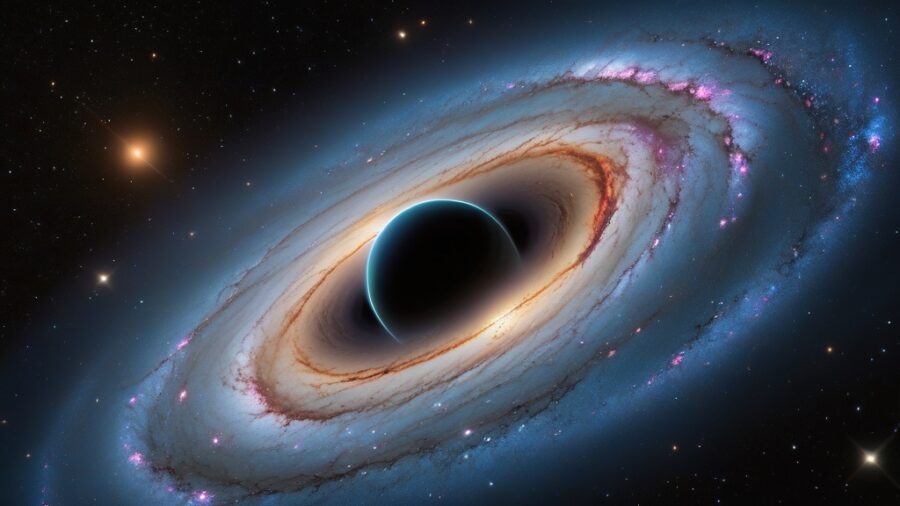
Understanding the Supermassive Black Hole Center
Supermassive black holes are one of the most intriguing phenomena in the universe. They are found at the center of virtually every large galaxy, including our Milky Way. The study of supermassive black hole centers offers critical insights into the formation and evolution of galaxies. This article aims to explore the various aspects of supermassive black holes, including their formation, their role in galaxies, and the techniques used to study them, as well as their impact on their surroundings.
Within the vast cosmic landscape, the existence of supermassive black holes challenges our understanding of physics and the nature of space-time. These entities, which can have masses equivalent to millions or even billions of suns, exert significant gravitational influence on their host galaxies. Additionally, the interaction between these black holes and surrounding matter leads to the emission of powerful radiation, making them observable across vast distances.
In the following sections, we will delve deeper into the formation of supermassive black holes, their implications for galaxy structure and behavior, and the observational methods scientists employ to study them. By the end of this article, you will have a comprehensive understanding of supermassive black holes and the ongoing research in this fascinating field.
The Formation of Supermassive Black Holes
Initial Theories and Mechanisms
The formation of supermassive black holes (SMBHs) has been a topic of significant debate and research in astrophysics. The leading theories suggest that they can form through several mechanisms, primarily involving the collapse of massive gas clouds in the early universe. When these gas clouds collapse under their own gravity, they can create dense regions that eventually evolve into black holes.
Another theory posits that SMBHs may form from the merger of smaller black holes, which themselves could result from the collapse of massive stars. As these smaller black holes come together, they can accumulate mass and grow into supermassive black holes over cosmic timescales. This process may also be aided by the accretion of surrounding gas and dust, which fuels the growth of these massive entities.
The Role of Dark Matter in Formation
Dark matter, which is believed to make up about 27% of the universe, plays a crucial role in the formation and growth of supermassive black holes. It provides the necessary gravitational scaffolding for galaxies to form and evolve. The presence of dark matter can influence the dynamics of gas clouds, making them more susceptible to collapse and consequently leading to the formation of black holes.
Furthermore, the interactions between dark matter and baryonic matter (ordinary matter) in the early universe could lead to the creation of dense regions conducive to black hole formation. Understanding these interactions is vital for unraveling the complexities of SMBH formation and their evolutionary paths.
The Role of Supermassive Black Holes in Galaxies
Influence on Galactic Structure
Supermassive black holes are not just passive entities; they play a vital role in shaping the structure and dynamics of their host galaxies. As they grow, they can influence star formation rates and the overall evolution of the galaxy. The gravitational pull of a supermassive black hole affects the orbits of stars and gas clouds within the galactic nucleus, leading to the formation of complex structures.
For instance, in galaxies with active supermassive black holes, we often observe high rates of star formation in the vicinity of the black hole, as gas is heated and compressed due to gravitational forces. This can lead to the formation of new stars and the re-energization of stellar populations within the galaxy.
Feedback Mechanisms and Active Galactic Nuclei
Supermassive black holes are also associated with phenomena known as active galactic nuclei (AGNs), where the black hole is actively consuming material. As matter falls into the black hole, it forms an accretion disk, which emits immense amounts of energy in the form of radiation. This process can have profound feedback effects on the surrounding galaxy.
For example, the energy released can heat up the surrounding gas, preventing it from cooling and forming new stars. This feedback mechanism can regulate star formation across the galaxy, impacting its evolution significantly. Understanding these interactions is crucial for comprehending the lifecycle of galaxies and their supermassive black holes.
Observational Techniques for Studying Supermassive Black Holes
Methods of Detection and Measurement
Studying supermassive black holes requires advanced observational techniques due to their distant and often obscured nature. One of the primary methods used by astronomers is the observation of the motion of nearby stars and gas clouds. By measuring their velocities and trajectories, scientists can infer the presence of a supermassive black hole and estimate its mass using Newton’s laws of motion or Kepler’s laws of planetary motion.
For example, observations of the stars orbiting the supermassive black hole at the center of our galaxy, Sagittarius A*, have provided critical data that suggest its mass is approximately 4.1 million solar masses. This was achieved using high-resolution imaging techniques over several years, allowing astronomers to track the movements of these stars accurately.
Utilizing Different Wavelengths
In addition to tracking stellar movements, astronomers also utilize various wavelengths of light to study supermassive black holes. X-ray emissions are particularly important, as they can indicate the presence of hot gas falling into the black hole. Instruments like the Chandra X-ray Observatory and the XMM-Newton satellite have been pivotal in identifying and studying AGNs across the universe.
Furthermore, radio telescopes play a crucial role in observing jets emitted from supermassive black holes. These jets can extend millions of light-years into space, providing valuable insights into the behavior of matter in extreme gravitational fields. By combining data from different wavelengths, astronomers can obtain a comprehensive view of these fascinating cosmic entities.
The Impact of Supermassive Black Holes on Their Surroundings
Gravitational Influence and Galactic Dynamics
The gravitational influence of supermassive black holes extends far beyond their immediate vicinity. Their immense mass can shape the entire galaxy, affecting the motions of stars and the distribution of gas and dust. This gravitational pull can lead to the formation of galactic structures such as bars and spiral arms, which are critical for understanding galaxy formation and evolution.
Additionally, supermassive black holes can influence the dynamics of their host galaxies by driving the motion of stars and gas in their vicinity. This interaction can result in complex evolutionary paths for galaxies, leading to various morphological types and star formation histories.
Energy Output and Cosmic Feedback
The energy output from supermassive black holes, particularly those classified as active, can have significant effects on the surrounding environment. The radiation emitted from accretion disks can heat the interstellar medium, impacting star formation rates and the overall evolution of the galaxy. This process is often referred to as cosmic feedback.
Studying the effects of this feedback is essential for understanding how galaxies evolve over time. For instance, in some galaxies, the energy released by a supermassive black hole can prevent gas from cooling and collapsing into new stars, effectively regulating the star formation process.
Future Research Directions in Supermassive Black Hole Studies
Advancements in Technology and Methodology
As technology continues to advance, the study of supermassive black holes is entering a new era. Upcoming telescopes and observational instruments, such as the James Webb Space Telescope, promise to provide unprecedented insights into the formation and growth of these massive entities. These advancements will allow astronomers to observe distant galaxies and their supermassive black holes in more detail than ever before.
Moreover, the development of gravitational wave astronomy has opened new avenues for studying black holes. The detection of gravitational waves from black hole mergers provides direct evidence of their existence and allows researchers to measure their masses and spins accurately.
Exploring the Early Universe
Another significant direction for future research is the exploration of supermassive black holes in the early universe. Understanding how these entities formed shortly after the Big Bang is crucial for unraveling the mysteries of cosmic evolution. The study of high-redshift quasars, which are powered by supermassive black holes, can provide valuable insights into this formative period in cosmic history.
By examining the properties and behaviors of these ancient quasars, researchers hope to learn more about the conditions that led to the formation of supermassive black holes and their impact on the development of early galaxies.
Conclusion
In conclusion, supermassive black holes are not just enigmatic cosmic entities; they play a vital role in the evolution and structure of galaxies. From their formation processes to their gravitational influence and feedback mechanisms, these black holes are intricately linked to the life cycle of galaxies. As observational techniques and technologies improve, our understanding of supermassive black holes will continue to deepen, revealing more about the universe’s history and the fundamental laws of physics.
The ongoing research in this field promises to uncover new insights and challenges, pushing the boundaries of our knowledge about the cosmos. By studying supermassive black holes, we not only learn about the nature of these fascinating objects but also gain a better understanding of the universe we inhabit.
Frequently Asked Questions about Supermassive Black Holes
1. What are supermassive black holes?
Supermassive black holes are black holes with masses ranging from hundreds of thousands to billions of solar masses. They are typically found at the centers of galaxies and have a significant influence on their host galaxy’s structure and evolution.
2. How do supermassive black holes form?
The formation of supermassive black holes is believed to occur through the collapse of massive gas clouds, the merger of smaller black holes, and the accretion of surrounding matter. These processes can take millions to billions of years to result in a supermassive black hole.
3. What is the significance of supermassive black holes in galaxies?
Supermassive black holes play a crucial role in shaping the structure and dynamics of their host galaxies. They influence star formation rates and can regulate the evolution of the galaxy through feedback mechanisms, impacting the formation of new stars.
4. How do astronomers study supermassive black holes?
Astronomers study supermassive black holes using various techniques, including tracking the motion of stars and gas around them and observing the radiation emitted from accretion disks. Advanced telescopes and instruments allow for detailed observations across multiple wavelengths.
5. What are the future directions for research on supermassive black holes?
The future of supermassive black hole research involves advancements in observational technology, such as the James Webb Space Telescope, and the exploration of high-redshift quasars to understand their formation in the early universe. These efforts aim to uncover the mysteries surrounding these cosmic giants.
Key Takeaways
- Supermassive black holes are found at the centers of most large galaxies.
- They can form through gas cloud collapse, mergers of smaller black holes, and gas accretion.
- SMBHs influence their host galaxies by regulating star formation and shaping galactic structures.
- Observational techniques include tracking stellar motions and analyzing radiation across different wavelengths.
- Future research will focus on technological advancements and exploring supermassive black holes in the early universe.
- Understanding supermassive black holes helps illuminate the fundamental laws of physics and the evolution of the universe.